Thursday, February 14, 2008

CURRENT EVENTS & MORE

UPDATED SAT. FEB. 16, 2008


barack obama in austin


Barack Obama's Gun-Related Votes


The U.S. Senate Debated:
Obama
Voted:
Supporting concealed carry for citizens10
Anti-gun
Banning many common semi-automatic firearms11
Anti-gun
Disallowing self-defense in towns where guns are banned12
Anti-gun
Imposing one handgun a month restrictions13
Anti-gun
Requiring lock up your safety trigger locks14
Anti-gun
Protecting gun dealers from frivolous lawsuits15
Anti-gun
Outlawing gun confiscations during a national emergency16
Pro-gun
Squelching the free speech rights of gun owners17
Anti-gun
Restricting the interstate sales of firearms18
Anti-gun
Repealing the gun ban in Washington, DC19
Anti-gun


1Associated Press, "Research finds Cheney, Obama distant cousins," October 17, 2007.
2Ibid.
3O.Kay Henderson, "Three leading Democrats talk about gun control," Radio Iowa News, April 22, 2007.
4James Oliphant and Michael J. Higgins, "Court to hear gun case," Chicago Tribune, November 20, 2007.
5Illinois State Senate, vote on SB 2165 (41-16), May 25, 2004.
6Obama says, "National legislation will prevent other states' flawed concealed-weapons laws from threatening the safety of Illinois residents." David Mendell, "Democratic hopefuls vary a bit on death penalty," Chicago Tribune, February 20, 2004.
7See the Gun Owners of America fact sheet at http://www.gunowners.org/fs0404.htm.
8John Chase, "Keyes, Obama are far apart on guns; Views on assault weapons at odds," Chicago Tribune, September 15, 2004.
9Senators Chuck Schumer and John Kerry had both cosponsored S. 1431 in 2003, a bill that would have banned any semi-auto shotgun that also contained a pistol grip, which the bill defined as "a grip, a thumbhole stock, or any other characteristic that can function as a grip." According to that definition, just about any semi-automatic shotgun would be banned.
10See supra note 6.
11About the so-called "assault weapons" ban, Obama says, "I believe we need to renew -- not roll back -- this common sense gun law." See supra note 8.
12See supra note 5.
13As a state senator, "Obama regularly supported gun-control measures, including a ban on semiautomatic 'assault weapons' and a limit on handgun purchases to one a month." "Obama Record May be Gold Mine for Critics," Associated Press, January 17, 2007.
14On July 28, 2005, Senator Obama voted for a provision requiring gun dealers to include the sale of a lock-up-your-safety device with every handgun sold. The amendment, offered by Sen. Herb Kohl (D-WI), passed by a vote of 70-30. The provision amended the gun makers' protection act (S. 397).
15On July 29, 2005, Senator Obama voted against S. 397, a bill that was designed to put an end to the frivolous lawsuits that were threatening to put many gun dealers out of business. While an argument could be made that a pro-gun Senator might vote against this bill because it contained a lock-up-your-safety provision (see supra note 14), the fact that Obama voted in favor of that trigger lock amendment (but against the overall bill) indicates his real animus against helping gun dealers protect themselves from the anti-gun lawsuits that were aimed at driving them into bankruptcy.
16On July 13, 2006, Sen. Obama voted for Emergency Powers language that saw only 16 of the most ardent anti-gun senators vote against it. The amendment provides that no money can be used by federal agents to confiscate firearms during a declared state of emergency. The amendment was added to the Department of Homeland Security appropriations bill (HR 5441).
17On January 18, 2007, Senator Obama voted against a pro-gun amendment to strike language in S. 1 that would infringe upon the free speech rights of groups like Gun Owners of America. The amendment, which passed, struck requirements that would have required GOA to monitor and report on its communications with its members, and could easily have led to government demands for GOA's membership list (a.k.a. registration).
18Obama has frequently made statements which indicate that he would restrict the interstate sale of firearms. For example, he told the NAACP that, "We've got to make sure that unscrupulous gun dealers aren't loading up vans and dumping guns in our communities, because we know they're not made in our communities. There aren't any gun manufacturers here, right here in the middle of Detroit." Senator Barack Obama, at the NAACP Presidential Primary Forum, July 12, 2007.
19See supra note 4.
**************************************************************************************


FBI on alert for threats to Jewish targets in the US - from Debka

February 14, 2008, 7:14 PM (GMT+02:00)

The Federal Bureau Thursday put its domestic terror squads on alert for any threats against synagogues and other potential Jewish targets in the United States following the death of Hizballah commander Imad Mughniyeh in Damascus Tuesday, Feb. 13. The FBI also ordered terrorism task forces through America to reach out to community sources for any information about stepped-up Hizballah activity. This high-priority order is unusual. these task forces are located in some 100 cities across the country.

************************************************************

BETTER READ THIS - OBAMA PUSHING BILL TO ALLOW UN TO BAN GUNS!

(AND PUSH ON GLOBAL UN TAX)

PLEASE CALL YOUR SENATOR RIGHT AWAY!
http://www.prisonplanet.c...

Obama Pushes Bill That Would Mandate Global Tax
Senate to vote on legislation that would cost U.S. $845 billion, also enables UN to implement gun bans...

Paul Joseph Watson
Prison Planet
Thursday, February 14th, 2008

Presidential frontrunner Barack Obama is pushing a bill that will lead to the implementation of a UN global tax, costing the U.S. at least $845 billion dollars over thirteen years in the name of fighting worldwide poverty, as well as banning "small arms and light weapons".

The "Global Poverty Act," which is sponsored by Obama, is up for a Senate vote today, and if passed would mandate the U.S. to spend 0.7 percent of the gross national product on foreign aid, on top of the money being sent out of the country already.

The bill passed the House by a voice vote last year because most members failed to read what was actually in it. The words "global" and "poverty" in the title were presumably enough to convince them that it must be good.

In reality, the bill also "Commits nations to banning "small arms and light weapons" and ratifying a series of treaties, including the International Criminal Court Treaty, the Kyoto Protocol (global warming treaty), the Convention on Biological Diversity, the Convention on the Elimination of All Forms of Discrimination Against Women, and the Convention on the Rights of the Child," writes Cliff Kincaid.

"Jeffrey Sachs, who runs the U.N.'s "Millennium Project," says that the U.N. plan to force the U.S. to pay 0.7 percent of GNP in increased foreign aid spending would add $65 billion a year to what the U.S. already spends. Over a 13-year period, from 2002, when the U.N.'s Financing for Development conference was held, to the target year of 2015, when the U.S. is expected to meet the "Millennium Development Goals," this amounts to $845 billion. And the only way to raise that kind of money, Sachs has written, is through a global tax, preferably on carbon-emitting fossil fuels."

A UN controlled global tax has long been a cherished goal of the elite and they have attempted to piggy-back it on numerous different pretexts, most recently via a global carbon tax on fuel, a move that was advanced at the recent summit in Bali.

During the summit, over one hundred prominent scientists signed a letter dismissing the move as a futile bureaucratic scheme which will diminish prosperity and increase human suffering.

In 2005, former French President Jacques Chirac called for the imposition of a global tax to finance the fight against AIDS.

Perfectly happy with giving Bush carte blanche to continue illegal spying on American citizens with the passage of this week's telecom immunity bill, the Senate seems destined to rubber stamp legislation that would lead to a global carbon tax.

President Bush has overseen the biggest increase in foreign aid since the Marshall Plan and is highly unlikely to veto the bill if it is passed.

Contact the Senate and voice your opposition to this bill. Call the switchboard at (202) 224-3121 and asked to be connected to the office of your Senator.

*********************************************************

WASHINGTON — Temper, temper.

Republican John McCain is known for his.

He’s been dubbed “Senator Hothead” by more than one publication, but he’s also had some success extracting his hatchet from several foreheads.

Even his Republican Senate colleagues are not spared his sharp tongue.

“F— you,” he shouted at Texas Sen. John Cornyn last year.

“Only an a—— would put together a budget like this,” he told the former Budget Committee chairman, Sen. Pete Domenici, in 1999.

“I’m calling you a f—— jerk!” he once retorted to Iowa Sen. Chuck Grassley.

With Cornyn, he smoothed things over quickly. The two argued during a meeting on immigration legislation; Cornyn complained that McCain seemed to parachute in during the final stages of negotiations. “F— you. I know more about this than anyone else in the room,” McCain reportedly shouted.

Cornyn chuckled at the memory of what he called McCain’s “aggressive expressions of differences.” The Texan has endorsed McCain.

“He almost immediately apologized to me,” Cornyn said last week. “I accepted his apology, and as far as I’m concerned, we’ve moved on down the road.”

The political landscape in Arizona, McCain’s home state, is littered with those who have incurred his wrath. Former Gov. Jane Hull pretended to hold a telephone receiver away from her ear to demonstrate a typical outburst from McCain in a 1999 interview with The New York Times.

McCain has even blown up at volunteers and, on occasion, the average Joe.

He often pokes fun at his reputation: “Thanks for the question, you little jerk,” he said last year to a New Hampshire high school student wondering if McCain, at 71, was too old to be president.

Other times, his ire is all too real. This has prompted questions about whether his temperament is suited to the office of commander-in-chief or whether it might handicap him in a presidential campaign against either Barack Obama or Hillary Rodham Clinton, who are not known for such outbursts.

“I decided I didn’t want this guy anywhere near a trigger,” Domenici told Newsweek in 2000.

His irascibility fits with McCain’s proud image as a straight talker willing to say what people don’t want to hear.

Yet McCain’s temper hinders his efforts to make peace with his critics and rally Republicans behind his candidacy for president. That could be a big problem, because his most persistent foes — conservative radio hosts like Rush Limbaugh and Focus on the Family founder James Dobson — talk to tens of millions of people each day.

McCain and his advisers insist the acrimony is about matters of policy: “We have disagreements on specific issues from time to time,” McCain recently said of his critics.

In fact, the disputes often are as much about style as they are about substance.

McCain’s tone was certainly on Dobson’s mind when he issued a stinging anti-endorsement on Super Tuesday. He mentioned various issues, but Dobson also said the senator “has a legendary temper and often uses foul and obscene language.”

Privately, some conservatives grouse that McCain can seem more convivial toward his liberal colleagues. Just last week, McCain had an animated conversation and shared a belly laugh with liberal Democratic Sen. Ted Kennedy, his partner on controversial immigration reforms, on the Senate floor.

And then there is his choice of words — not just the expletives, but also the use of dismissive phrases such as “agents of intolerance” to describe televangelists Pat Robertson and Jerry Falwell during the 2000 presidential campaign.

Yet McCain reconciled with Falwell before his death in 2007 and has done so with many others.

McCain has also smoothed things over with Sen. Thad Cochran, who had said very recently that the idea of McCain as GOP nominee sent a chill down his spine. McCain has battled for years with the Mississippi Republican, a senior member of the Senate Appropriations Committee, over pet projects or “earmarks” inserted by committee members into spending bills.

On the Senate floor last Tuesday, Cochran greeted McCain warmly, with a broad smile and a hug.

Grassley described his relations with McCain as “friendly, but not close.”

“John’s a person that I have a lot of disagreements with, but you’ve got to have a lot of respect for him,” Grassley told reporters recently. “For what he’s done to defend freedom, as a Navy pilot and as a POW, you’ve got to have a lot of respect for him for sticking to his guns, being way out ahead of the president that the policy needed to change in Iraq.”

“I’m not speaking as if I’m a born-again supporter of John McCain, I’m just trying to express it the way that I see him, and maybe some aspects of him being a good president,” Grassley said.

McCain’s defenders are weary of talk about his temperament. They point out that for all the decorum of the Senate, many members are known for raging at colleagues or even throwing shoes and other objects at aides.

For that matter, Dobson, the Focus on the Family founder so concerned about McCain’s “legendary temper,” apparently has a temper of his own. “He once berated one of our staffers to tears because he simply had to wait a few minutes to see the member,” said a Capitol Hill aide who requested anonymity out of deference to his boss. Another aide said he witnessed the scene.

Since he rolled up big victories on Super Tuesday and forced his main rival, Mitt Romney, from the race, McCain has worked quickly to win over his enemies.

He delivered a well-received speech at the annual Conservative Political Action Conference in Washington, and he met last week with some of his biggest congressional foes, the uniformly conservative House Republican leadership.

Progress won’t happen overnight, said conservative Republican strategist Greg Mueller.

“I hope they’ll be resolved by the time we all go to convention, but it’s going to take a while to mend some of the wounds and get everybody back together,” Mueller said.

The image “http://www.elephantbiz.com/uploads/mccain-immigration-kennedy.gif” cannot be displayed, because it contains errors.

***********************************************************

MUST READ

go to www.actionsbyt.typepad.com

.....................................................................................

YOUR AMMUNITION IS IN DANGER OF BECOMING OBSOLETE - THIS BILL WANTS TO KEEP YOU FROM BUYING AMMO AND PREVENT RELOADING. PLEASE CHECK INTO THIS...................................................................

HB 2833 requires all ammunition manufacturers to encode a unique serial number on the base of every bullet and on the inside of every cartridge. The bullet serial number and cartridge casing serial number would have to be identical.

This means two things. Home reloading will become illegal, and the price of manufactured ammunition will double.

If they can;t grab the guns, they will make the ammo hard to get.


HB 2833


Introduced by

Representatives Garcia M, Lopez: Alvarez, Bradley, Campbell CL

AN ACT

amending title 41, chapter 12, article 5, Arizona Revised Statutes, by adding section 41-1772; relating to the department of public safety.

Be it enacted by the Legislature of the State of Arizona:

Section 1. Title 41, chapter 12, article 5, Arizona Revised Statutes, is amended by adding section 41-1772, to read:

START_STATUTE41-1772. Ammunition coding system database; sale of ammunition; tax; fund; civil penalty; violation; classification; definition

A. Beginning january 1, 2009, a manufacturer shall code all handgun and ASSAULT weapon AMMUNITION that is manufactured or sold in this state. This section applies to all calibers.

b. Beginning january 1, 2011, a private citizen or a retail vendor shall dispose of all noncoded AMMUNITION that is owned or held by the citizen or vendor.

c. The department shall establish and maintain an ammunition coding system database containing a manufacturer registry and a vendor registry.

D. A manufacturer shall:

1. Register with the department in a manner prescribed by the department by rule.

2. Maintain records on the business premises for at least seven years concerning all sales, loans and transfers of ammunition to, from or within this state.

3. Encode ammunition provided for retail sale for regulated firearms in a manner that the director establishes so that:

(a) The base of the bullet and the inside of the cartridge casing of each round in a box of ammunition are coded with the same serial number.

(b) Each serial number is engraved in such a manner that it is highly likely to permit identification after ammunition discharge and bullet impact.

(c) The outside of each box of ammunition is labeled with the name of the manufacturer and the same serial number used on the cartridge casings and bases of bullets contained in the box.

4. Pay the tax levied by subsection I of this section.

E. A manufacturer shall not label ammunition contained in one ammunition box with the same serial number as the ammunition contained in another ammunition box that is produced by the same manufacturer.

F. A vendor shall:

1. Register with the department in a manner prescribed by the department by rule.

2. Record the following information in a format prescribed by the department:

(a) The date of the transaction.

(b) The name of the purchaser.

(c) The purchaser's driver license number or other government issued identification card number.

(d) The date of birth of the purchaser.

(e) the unique identifier of all handgun ammunition or bullets transferred.

(f) All other information prescribed by the department.

3. Maintain records on the business premises for at least three years after the date of the recorded purchase.

G. The department shall establish the ammunition coding system database within the framework of any existing firearms databases.

H. Access to information in the ammunition coding system database is reserved for law enforcement personnel. The department shall only release information in connection with a criminal investigation.

I. A tax of one-half cent is levied on each bullet or round of ammunition that is sold in this state. The department of revenue shall collect the tax and deposit the tax, pursuant to sections 35-146 and 35-147, in the coded ammunition fund established by subsection J of this section.

J. The coded ammunition fund is established consisting of monies deposited pursuant to subsection I of this section. The department shall administer the fund. Subject to legislative appropriation, monies in the fund shall be used for the purpose of establishing and maintaining the ammunition coding system database prescribed by this section.

K. a manufacturer that fails to comply with this section is subject to a civil penalty of not more than one THOUSAND dollars for the first violation, not more than five thousand dollars for a second violation and not more than ten thousand dollars for any subsequent violation.

L. a vendor who knowingly fails to comply with this section or who knowingly falsifies the records REQUIRED to be kept by this section is guilty of a class 3 misdemeanor.

M. a person who knowingly destroys, obliterates or otherwise renders unreadable the coding REQUIRED by this section is guilty of a class 3 misdemeanor.

N. for the purposes of this section, "code or coded" means a unique identifier that has been APPLIED by etching onto the base of a bullet or ammunition projectile. END_STATUTE

Sec. 2. Requirements for enactment; two-thirds vote

Pursuant to article IX, section 22, Constitution of Arizona, this act is effective only on the affirmative vote of at least two-thirds of the members of each house of the legislature and is effective immediately on the signature of the governor or, if the governor vetoes this act, on the subsequent affirmative vote of at least three-fourths of the members of each house of the legislature.

************************************************************


Israel’s army chief orders IDF land, sea and air forces to prepare to defend the country’s northern borders and interests

February 14, 2008, 4:43 PM (GMT+02:00)


Defense minister Ehud Barak said the entire national defense system is fully prepared and alert as heavy Israeli reinforcements, including homeland defense units, were rushed Thursday to northern Israel.

Lt. Gen. Gaby Ashkenazi gave these orders Thursday, Feb. 14, 24 hours after a bomb killed Hizballah’s military commander Imad Mughniyeh in Damascus.

DEBKAfile’s military sources report that he took these unprecedented steps following a stream of incoming intelligence updates reporting that Iran, Syria and Hizballah had decided not to let Mughniyeh’s death pass without an immediate response.

Israeli forces have been placed on the highest level of preparedness against possible Syrian or Hizballah cross-border strikes. Rocket attacks by Hizballah against Israeli civilians are also taken into account, as well as possible Syrian air force incursions into Israel air space.

Jerusalem has denied Hizballah and Iranian allegations of responsibility for the death of the Lebanese master terrorist.

DEBKAfile reported earlier Tehran, Damascus, Hizballah leadership are coordinating efforts to wreak their revenge for Mughniyeh’s death, convinced that Israel’s Mossad planted the small bomb in the master terrorist’s Mitsubishi Pajero in the heart of the Syrian capital. Wednesday night, all Hizballah’s top leaders went to ground. Hassan Nasrallah did not attend the funeral Thursday but broadcast his eulogy by video. He declared if Israel wants war, so be it. "The blood of slain commander will lead to Israel's demise."

Our sources report that the long-sought terrorist was finally dispatched by a small explosive inserted between the driver’s seat and the back seats, which destroyed only one part of the vehicle, leaving the front and rear intact. Mughniyeh was driving alone to a reception marking Islamic Revolution Day at the Iranian embassy in the Romana district.

DEBKAfile’s counter-terror experts note that the way the explosion was set up recalled the method used by the hit team which killed the Jihad Islami senior operative Ghaleb Ghali in Damascus in October 2004. Then, too, Syria held Israel responsible.

*******************************************************************************************

http://www.shelleytherepublican.com/wp-content/uploads/2007/01/scary-hillary-clinton.jpg


***************************************************

COLD STEEL BLACK SABLE KNIFE - RECOMMENDED


Cold Steel Black Sable

*****************************************************


38 Special or 380 ACP ?

BY STEPHEN CAMP

www.hipowersandhandguns.com

Despite there being more potent handguns available in similar size packages, these two calibers continue to take a significant portion of the defensive handgun market share. As both remain popular, we see debate on a regular basis concerning which is the "best."

John M. Browning's .380 ACP cartridge continues to be popular with those using the caliber for self-protection. I've not yet tried the Guardian ammunition as it's relatively new, but the fact that ammunition makers are bringing out new loads for this "underpowered" round speaks to its continued popularity.

Ditto the .38 Special round! The same company brought out a +P load recently. Reportedly, this one did pretty well in some of the 10% gelatin/4-layers of denim expansion and penetration tests. I have not yet shot any of it, but will in the near future.

Though more recent additions exist, S&W continues to produce snub .38's as it has for decades. Newer guns are made of titanium and/or scandium. The one shown above is the older aluminum alloy frame from their "Airweight" series.

For most of the last century and still popular today, Walther PP-Series pistols have been popular. The top one is a .380 and the one at the bottom's chambered for .32 ACP.

A more recent addition to the .380 line up is Bersa's "Thunder 380." If these .380 pistols were not selling, new models would not be invested in and produced.

Rightly or wrongly, both calibers seem to remain popular. Which is best between these two calibers?

The answer depends primarily on a couple of things:

1. Which caliber do you think is the more potent "stopper"?

2. Which type handgun do you prefer, revolver or automatic?

As I see it, the .380 might be a little short on penetration when JHP ammunition is used and it expands. It seems that the average penetration depth for most JHP's in this caliber is about 7 to 9 inches in ballistic gelatin. For a frontal, face-to-face shot, this might very well be sufficient, but for an angled shot or one passing through an arm first, it very well might not. It seems that there's just not enough bullet weight at .380 velocities to push the expanded slug deeply enough. While there certainly are felons who'll "stop" simply because they are shot, there are also those who will not unless they're physically unable to continue.

In conventional JHP, .380 bullets weigh from 85 to 102 grains.

From a snub .38 Special, HP bullets weigh from about 95 to 158 grains. These can be had with gilding metal jackets or pure lead in some cases. Where the .380, depending upon barrel length, will throw 90-grain JHP's at about 950 to 1100 ft/sec, the .38 will hit similar velocity levels with 110 grain bullets and approximately 800 ft/sec + with the 158-gr +P loads. These do offer more penetration in 10% ballistic gelatin when they expand. Both are capable of through-and-through penetration in a human torso if they do not.

Neither is a powerhouse ballistically and most opine that either is about as low on the ladder as one should go for a viable defensive handgun. I agree. Unless there's some compelling special reason, I personally will not go below either .380 or .38 Special for self-protection.

Those favoring the automatic will cite that it holds more rounds and that today's pistols are reliable. Reloading via loaded magazines is also both easier and quicker with the automatic. The fact that the .38 will have more recoil is also mentioned. The revolver team cites round-to-round performance and the historical reliability of the revolver, particularly when compared to the small automatics.

If limited to the choice of the .38 vs.380, I prefer the snub revolver. This is simply because I believe the thirty-eight offers a little more ballistically than does the little automatic round. I do agree that with some pistols, the .380 is easier to shoot well and it is quicker to reload, but I try and make up for this in frequent practice, including reloads.

Neither is optimal and both might be considered at least adequate for self-protection, but either must be shot accurately to stop an aggressor.

If you're pondering this choice and simply cannot get the hits with the snub and cannot find the time for instruction and practice, you might find the .380 an easier pistol to shoot. (I'm not speaking of the really small ones, but those the size of the Walther, Bersa, or even CZ .380's.) If you go this route, I believe that you're at the absolute lower limit of "protection power."

Frankly, either is probably best as a back up gun, but like so many, my orbits are tame and I find the snub .38 my primary defensive handgun. If you opt for this too, I strongly suggest practice.

Either gun can serve, but I'll cast my lot with the .38 Special.

*****************************************************************************

FENIX TACTICAL FLASHLIGHT - RECOMMENDED - NOT A STROBE - VERY HIGH IN LUMENS

Fenix Tactical T1 Olive Finish


www.actionsbyt.com

www.actionsbyt.blogspot.com

www.tacticalknives.blogspot.com

www.actionsbyt.typepad.com

www.actionsbyt.wordpress.com

www.truthaboutparts.blogspot.com

www.commentsbyt.blogspot.com

www.tjofsugarland.blogspot.com

www.handgunpartsforsale.blogspot.com

www.hipowersandhandguns.com

www.mouseguns.com

www.trippresearch.com

www.wowtexas.com

http://www.spw-duf.info/links.html#guns

*********************************************************
"MORONS AT WORK"
WHATS YOUR LIFE WORTH ??

Home Trigger Job for Guardian


« Previous Next »
Author Message
Top of pagePrevious messageNext messageBottom of page Link to this message

Nicknolte99
Message Board Member
Username: Nicknolte99

Post Number: 1
Registered: 02-2008
Posted on Thursday, February 14, 2008 - 11:46 pm:

I cut down the hammer spring a few coils to make the trigger lighter on my guardian 32. I havent gotten a chance to fire it yet so im a little nervous but the trigger pull dropped a good 4-5 lbs.

Has any one else done this and is there any negative things that could result from this? it sems like the hammer is still falling hard enough to fire but i havent shot it yet.
Top of pagePrevious messageNext messageBottom of page Link to this message

Mi_packer
Message Board Member
Username: Mi_packer

Post Number: 1
Registered: 02-2008
Posted on Friday, February 15, 2008 - 04:27 am:

I just ordered a new spring so I could try this exact technique. How many coils did you cut off?

When you test fire please lets us know what ammo you used. For example, one of my competition guns has a lightened trigger, becasue of the lighter strikes only federal primers will light up.

I have polished everything internally and have reduced a lot of the gritty feel. I'm still studying that last part of the trigger pull. I'm thinking that changing the angle just a little will help there. The problem is these look like MIM parts (drawbar and hammer) and I'm afraid of taking off heat treated metal and exposing soft metal.
Top of pagePrevious messageNext messageBottom of page Link to this message

Mi_packer
Message Board Member
Username: Mi_packer

Post Number: 2
Registered: 02-2008
Posted on Friday, February 15, 2008 - 10:57 am:

Quick update. The spring came today so I started triming it back. After triming 1.5 coils I had a 10lb 14 oz pull. I trimmed off another .5 coil and now have a ten pound pull (two coils removed).

My trigger gauge maxs out at 12 pounds so I don't know what it was before.

Test fired WWB and Winchester Silvertips. No problems touching off either.

I have added a strip of 3M stair tread tape to the front and back straps and I like that. I don't usually put a finger in front of the trigger guard. But I should try it out with some grip tape there as well.
Top of pagePrevious messageNext messageBottom of page Link to this message

Nicknolte99
Message Board Member
Username: Nicknolte99

Post Number: 2
Registered: 02-2008
Posted on Friday, February 15, 2008 - 01:49 pm:

I took off around 3 coils, the hammer even sits a little slightly back, maybe less than a millimeter. I poured a ton of hoppes down the hammer spring channel as well this really smoothed it up.

Racking the slide now is way easier. I plan on test firing either tonight or tommorrow. Gonna try some wwb and aquila or fiochi fmj.
Top of pagePrevious messageNext messageBottom of page Link to this message

Nicknolte99
Message Board Member
Username: Nicknolte99

Post Number: 3
Registered: 02-2008
Posted on Friday, February 15, 2008 - 02:11 pm:

actualy looking at it again probably closer to 4 coils if you count the top as 2. The drawbar doesnt look too durable, but the piece where the hammer connects looks a bit thicker.
Top of pagePrevious messageNext messageBottom of page Link to this message

Mi_packer
Message Board Member
Username: Mi_packer

Post Number: 3
Registered: 02-2008
Posted on Friday, February 15, 2008 - 03:44 pm:

I read another post where the trigger job resulted in an 8 pound trigger. They didn't get into any details about the trigger job. Just said it was reliable touching off rounds.

I wonder if the firing pin spring needs to be reduced as the hammer spring is reduced.

I worry that the drop safety aspect of the firing pin spring (if it exist) is reduced as the spring is reduced.

Moly grease, just a little, is on my hammer spring helped some. Polishing where the trigger rubs against the frame seemed to help the most.
Top of pagePrevious messageNext messageBottom of page Link to this message

Billinpittsburg
Message Board Member
Username: Billinpittsburg

Post Number: 1374
Registered: 01-2003
Posted on Friday, February 15, 2008 - 08:15 pm:

Don't cut coils to reduce trigger pull. The spring needs to be a certain strength for a reason, and cutting hammer spring coils could result in light strikes.

A gunsmith who does a proper trigger job will generally attempt to make sure everything is squared off where it should be square, closer to the ideal measurement within the tolerance range, and smoothed up where necessary (Teddy Jacobson uses jeweling to better hold lubrication). Done properly, the trigger pull on a Guardian can be taken down a few pounds this way.

Tuesday, February 12, 2008

STEPHEN CAMP - MASTER GUN WRITER

UPDATED FEB. 13, 2008

VERY SHOCKING AND VERY TROUBLING STORY - DISCLAIMER, AS I DO NOT KNOW WHAT TO THINK ABOUT THIS, ITS GIVEN ME SLEEPLESS NIGHTS. LINK IS UP FOR YOU TO DECIDE FOR YOURSELF.

http://educate-yourself.org/cn/earlhopperinterview08feb08.shtml

*****************************************************************************
CHE GUEVARA FLAG IN OBAMA'S HOUSTON, TX. OFFICE


Major coup in war on terror: Notorious Hizballah terrorist hostage-taker Imad Mughniyeh killed in Damascus

February 13, 2008, 2:40 PM (GMT+02:00)

Rare photo of elusive terrorist Imad Fayez Mughniyeh

Rare photo of elusive terrorist Imad Fayez Mughniyeh

DEBKAfile’s military sources report that Imad Fayez Mughniyeh, the Hizballah’s supreme commander and plotter of major anti-US and anti-Israel terror operations in the last 25 years reportedly died in a car bomb explosion in the Damascus district of Tanzim Kafr Susa Tuesday night, Feb. 12.

Hizballah TV interrupted its broadcasts Wednesday to announce his death, accusing Israel of assassination. Hizballah TV interrupted its broadcasts Wednesday to announce his death, accusing Israel of assassination. Its leaders are conferring in Beirut on how to retaliate. Special security imposed at Israeli embassies and Jewish centers worldwide.

The Iranian News Agency reports that Haj Hussein Khalil, the Hizballah’s deputy for political affairs was killed in the same explosion.

Hassan Nasrallah will eulogize the dead man at his funeral in Beirut Wednesday by video link. Beirut is already tense since the funeral falls on the third anniversary of the assassination of former Lebanese prime minister Rafiq Hariri.

On Aug. 5, 2006, DEBKAfile described Mughniyeh as the only undercover agent in the Middle East who enjoys the complete personal trust of both Iranian supreme ruler Ayatollah Ali Khamenei and al Qaeda’s Osama bin Laden. In recent years he has liaised between them. His death is a blow to both.

The elusive Mughniyeh surfaced before both of them on the Islamist terror horizon. In 1982, He orchestrated the suicide bombings of US Marine and French Beirut headquarters, in which 241 Marines and 58 French soldiers were killed, prompting a decision by President Ronald Reagan to evacuate US troops from Lebanon.

In 1983, he orchestrated the US embassy bombing, which killed 63 people and wiped out the top CIA Middle East staff. That year, the Israeli command center in Tyre was blown up killing scores of troops.

In 1985, the United States indicted him for hijacking TWA Flight 847 and the resulting death of U.S. Navy diver Robert Stethem.

Mughniyeh was also infamous for numerous brutal kidnappings of Westerners in Beirut through the 1980s, most notably, that of Terry Anderson and U.S. Army Col William Francis Buckley, who was later murdered.

The dead terrorist’s association with Tehran and its violent overseas exploits went back twenty years. In 1988, in collusion with Tehran, he organized the kidnapping of Colonel William R. Rich Higgins, the most senior American intelligence officer in Lebanon, who was tortured to death by Iranian Revolutionary Guardsmen and Hizballah operatives.

The same partnership is believed to have staged the Khobar Towers blast in eastern Saudi Arabia on June 25, 1996, targeting US flight crews guarding Saudi oil fields. At least 19 Americans were killed and 200 injured.

Mughniyeh, acting for Tehran and Hizballah, was held responsible for the 1992 bombings of the Israeli embassy and Jewish cultural center in Buenos Aires, in which more than a hundred people died.

He planned the kidnap and murder of three Israeli soldiers eight years ago and his hand is believed behind the abduction of two Israeli reservists in 2006.

After numerous attempts to capture him, the FBI in Oct. 2001 put him on its list of 22 most wanted terrorists and a $25 million bounty on his head the same as for bin Laden.

The dead terrorist mastermind’s first mentor was the Palestinian Yasser Arafat as a member of the Fatah’s Force 17.

While America and Israel come first to mind as responsible for Mughniyeh’s death, DEBKAfile’s counter-terror sources note that a possible inside job is worth considering. Dissatisfied with his performance in the 2006 Lebanon War against Israel, Tehran deposed Hizballah’s secretary-general Hassan Nasralah as its supreme commander and replaced him with Mughniyeh.

Nasrallah was confined to political functions, while his successor was assigned the task of rehabilitating Hizballah militia forces and preparing them for the next war on Israel.

The dead terrorist may have set up his headquarters in Damascus under the protection of Syrian and Iranian security services because he did not feel safe in Lebanon. Penetrating these two security belts to slay the wanted man was undoubtedly an exceptional intelligence feat.

*********************************************************************************************


COLD STEEL VOYAGER KNIFE - RECOMMENDED

Cold Steel large Voyager Series clip point

FROM BOSTON - MUST READ

************************************************************************************************

FOR COMPLETE MAKAROV ARTICLE GO TO
http://actionsbyt.typepad.com/actionsbyt/2008/02/makarov-article.html

********************************************
NEW GUNSMITH FORUM
http://thegunsmiths.com/phpBB2/

********************************************

www.actionsbyt.com

www.actionsbyt.blogspot.com

****************************************************************

Automatics: What Action Type for Me?

By Stephen Camp

Perhaps more today than ever before the prospective handgun buyer can be bedazzled by the array of semiautomatic pistols available, and for some these seemingly infinite choices can be confusing. Assuming that our buyer has waded through the endless debates on "stopping power" and had decided on caliber, he or she still has to decide not only on brand, but action type. Sometimes the brand will dictate this; sometimes not. What should he or she get: Single-Action, DA/SA, DAO, "Selective DA", Safe Action, or DAK? For the more seasoned members of the handgunning community, this may not be a problem, but for those just starting out, the same is probably not true. It gets a little more confusing with other options such as exposed hammers vs. striker-fired or the merits for and against spur hammers vs. ring, etc.

Let's take a look at the different categories of semiautomatic pistols available today and visit both their general characteristics as well as perceived good and not so good points. I will do my best to provide objective answers but will also add my own personal observations based on shooting and using each type action. I ask the reader to decide which questions concerning each action type are most important to him. Forget the "everybody knows" this or that is "best." Decide on those factors most important to you. Does this mean that if you do this you're sure to buy just that perfect pistol? Nope, but I think you stand a better chance. This is also why I'm including my personal long-term observations on the different action types as a shooter. The way a handgun is described and its actual shooting characteristics may not be one and the same.

Single-Action: Though some of the early automatics were striker-fired rather than having a separate hammer and firing pin, those with the exposed hammer were almost always single-action. In other words, the trigger performed one function; it dropped the hammer and fired the pistol. Before any shot could be fired, the hammer had to be manually cocked. This could occur by thumbing back the hammer when a live round was already chambered or when retracting and releasing the slide to chamber a round from the magazine.

This 1911 pattern pistol is a prime example of the single-action semiautomatic handgun. The hammer must be cocked manually before the first shot can be fired. After that it is self-cocking. This type action provides for a constant trigger pull from the first to the last shot. With the 1911 it is possible to obtain very light and very crisp trigger pulls. It also has an extremely short reset.

The Hi Power, also known as the P35 to many, is another classic example of the single-action automatic. In original trim, its trigger also only drops the hammer. Because of the shape of its trigger some folks mistakenly believe that it is a double-action pistol though it most certainly is not.

The single-action autopistol remains a favorite with "old" shooters who teethed on it in their beginning days as well as some newer members of the handgunning community. The reason is simple; its design allows for most easily getting accurate hits, be the target paper or something else. The single-action trigger pull can be lighter than any other type. Thus, less pressure is required to fire the shot. This means that it is easier to maintain proper sight alignment when the shot is fired. Particularly with the 1911-type pistol, subsequent shots can be made with extreme speed due to the super-short reset. In other words, the trigger finger doesn't have to let the trigger move forward but a small fraction of an inch before the pistol is ready to fire again.

The traditional type single-action automatic most popular today is without question Mr. Browning's 1911 in one form or another but another is steadily gaining ground. That would be Springfield Armory's XD series. Though striker-fired, the trigger performs but one function. It releases the spring-loaded striker from a fully retracted position to fire the gun, which exactly parallels the traditional single-action's hammer being dropped from full-cock to strike the firing pin. Heckler & Koch's P7 series of handguns can be considered unique among single-actions autos. While they are striker-fired, the striker is safely at rest until the pistol is gripped tightly enough for the "squeeze cocker" on the front strap to retract it. Like all single-actions, the trigger does nothing other than to release the hammer or striker.

In my opinion, the single-action automatic remains the best choice for shooting accurately in both slow and rapid-fire, but does that make it the top choice for all people and all situations? The single-action automatic in 1911 form is often the pick of the litter for such "high speed/low drag" groups as the FBI Hostage Rescue Team, Delta, as well as other specialized military and police groups. Does that mean that the single-action auto is simply the best choice, period? In my opinion, the answer is no. Let's look at that for a few minutes.

The attributes making the single-action automatic especially the 1911-pattern pistol easy to shoot straight and fast in trained hands are a very light trigger pull that is both short and quick to reset. These very same characteristics can work against it, making it more "dangerous" than other action-types. I use "dangerous" in quotes because I believe that while the gun is mechanically safe and a century of use proves that up, when we put the human being into the mix things can change. The single-action auto is very intolerant of incompetent gun handling. A finger on the trigger in a time of stress with the manual safety disengaged, either inadvertently or on purpose, can very easily lead to a negligent discharge. The easier a pistol is to fire, the more care there must be in its being handled properly. Safe gun handling is not an option with the single-action automatic. While this is true with any firearm, inept handling will probably show up sooner with the single-action…sometimes with tragic results.

The (false) perception that a cocked-and-locked single-action auto is unquestionably unsafe is one reason why we do not see more single-action automatics in police and military holsters. Assuming good mechanical condition, the single-action automatic is simply not going to fire unless the safeties are disengaged and the trigger pressed. The problem arises in the short and light trigger's being pressed when not intended. We see this when users who have not learned safe gun handling to the degree that it is second nature. In an absent-minded moment or when in a panic situation, the finger finds its way to the trigger with the safety in the off position.

But, there can be other problems as well and they stem from the fear of "cocked-and-locked" or "Condition One" carry. They are "Condition Two" and "Condition Three" for the single-action auto.

Condition Two describes a single-action autoloader having a chambered round and loaded magazine but with the hammer resting all the way forward against the rear of the firing pin. This is a safe enough condition assuming that the pistol has an inertial firing pin or internal firing pin lock. In this condition, the hammer must be manually brought to full-cock before the pistol can be fired. This is a two-fold problem as I see it. First, lowering the hammer by hand while pressing the trigger can result in the pistol being negligently fired if handler's thumb or fingers slip. That said, I've known more than a few old-time peace officers that managed this relatively simple task with no problems but the potential remains. To get the gun to fire in an emergency situation while under stress can also lead to obvious problems and it is slower than merely disengaging a thumb safety and pressing the trigger to fire.

Condition Three describes a single-action automatic with only the magazine loaded. To get the pistol into firing mode, the slide is retracted and released. If the pistol is not being immediately used in a deadly force scenario, the thumb safety should be engaged. In other words, the gun goes to Condition One. Why not just begin there? A question often asked is whether or not the mainspring is weakened by continually leaving the hammer cocked. The answer is simply no. In a quality spring such as those from the major gun makers, there is no weakening from this. What weakens springs is use. Compressions when the hammer is cocked and decompressions when the hammer springs forward are what weaken springs. Another assumption implicit to Condition Three carry is that the user will always have both hands free when it comes time to activate the pistol. Obviously, this may not be true.

The best case that can be made for this mode of carry is that if the magazine in the pistol is the only one readily available, the gun can be rendered incapable of firing by simply removing and pocketing the magazine. I am not a fan of Condition Three primarily because of its requiring two hands to ready the gun in an unforeseen situation.

Conventional Double-Action: As most will already know, these pistols require a long initial trigger pull to both cock and release the hammer with subsequent shots being fired single-action. This is the type action that Col. Cooper (and others) held in low esteem. I believe that he once referred to it as "the badge of the incompetent." Though I respected Jeff Cooper quite a lot, I do disagree with that last statement but do agree that there definitely is a difference between the first DA shot and the SA shots that follow. At the same time and depending upon the pistol I have not found that transition to be as great as I had initially expected. I believe that this will differ from person to person, but an experienced shooter can probably shoot a DA/SA conventional automatic very well if he finds the right one. Just as felt recoil and beauty are subjective entities, so I think it may be with the conventional double-action's different trigger pulls for double and single-action shots.

I do not believe that firing this type pistol in double-action consistently results in more easily made precise shots as with the light crisp single-action automatic's trigger pull. At the same time I do not believe that one is doomed to having to "throw away the first double-action shot" as some have recommended. With certain conventional double-action pistols, I might not get an "X" with the heavier DA pull but neither will it have to be a miss or near miss. On an IDPA type target that is shot with a balance of both speed and coarser accuracy than slow-fire bullseye shooting, the practiced double-action auto shooter gives up very little if anything in my observations of both experienced police shooters as well as the beginners.

Each of these shots was fired with a SIG-Sauer P220, a conventional DA/SA automatic, and were fired using double-action only. Distance was 15 yards. Now, this will not win any prizes at Camp Perry, but if required to shoot double-action with a quality autoloader, one is not so immediately damned to failure as some might expect…or proclaim. To me it is more difficult to get a tight group or hit a smaller target using double-action in the auto, but there could be other factors to consider than how easily an automatic lends itself to precise target work.

At 10 yards, I performed several "Failure to Stop" drills. Starting from a low ready, I brought the gun to eye level and fired the first shot double-action at the chest. As fast as I could obtain a "flash sight picture" a second shot was fired single-action. A third shot was fired at the head in the single-action mode. While neither this target nor myself are any threat to accomplished IPSC shooters, I think it does show that emergency work can be done with the conventional double-action automatic. If one wants to merely shoot as small a group as he can, the pistol can be thumb-cocked and all shots fired single-action. The same could hold true for the policeman's "rescue shot" fired from concealment if his DA/SA sidearm was all that he had and the shot had to be made. While the manual of arms for the conventional DA/SA auto is necessarily a bit longer than for the single-action, it is not like trying to learn multivariable calculus; it just requires study and the will to practice it. I think that it is a true statement that people not willing to put forth the amount of effort required to at least be competent with a firearm shouldn't count on one for anything more than slow-fire at paper targets…if that!

I know that it is not recommended, but on the relatively rare occasion I simply carry an automatic stuck in my waistband without a holster, I prefer double-action to a cocked-and-locked single-action autopistol.

One advantage that I see to the conventional DA/SA automatic is that usually they have some sort of decocking lever. Sometimes it is incorporated into the thumb safety and sometimes not, but the hammer never has to be lowered by easing the hammer down by pressing the trigger. I have no problem with people easing the hammer forward while using the decocker but consider it unnecessarily foolhardy if the decocking system is not used at all!

Many years ago, I "tested" myself on the difficulty in using the conventional double-action auto compared to the single-action. The pistols used were a Walther P38 for the double-action and a Colt Gov't Model for the single. There was a noticeable difference. About 15 years ago, I repeated this comparison with the same Gov't Model but using a CZ-75 and SIG-Sauer P220 for the double-actions. The difference was marked. Neither of these pistols is as muzzle light as the P38, but I think that the main difference was in the double-actions themselves. The CZ's was light and smooth but longer. The SIG-Sauer's was a little heavier but shorter. In any event, I found it much easier to shoot well in double-action with these two pistols and was surprised at the pleasing results.

For me, a disadvantage of the conventional DA/SA automatic is the exterior thumb safety. Though not all have them, many do and they are awkwardly mounted on the slide and operate in just the opposite directions of the single-action's; i.e. up is to fire and down is safe. Some of these merely act as decockers and are spring-loaded to return to the fire position when released.

There is some debate on whether or not to carry the conventional DA/SA with the safety on or off…if there is a choice. Arguments can be made for either side, but unless the safety is frame-mounted with down for fire and up for safe, I do not engage the safety if carrying such a pistol. Others may feel just the opposite and I have no issue either way other than to strongly suggest that one be proficient enough to disengage the awkward safety quickly and without having to fumble or think about what to do if the firearm is immediately needed.

Selective Double-Action: This term refers to those automatics capable of both double and single-action fire having an external safety that does not drop the hammer. In other words, it doesn't double as a decocking lever. One of these would be the CZ-75 and many of its variants although some are available with decocking levers. Another would be the Taurus PT-92 and 99. These are capable of double-action for the first shot and single-action shots thereafter, but they can also be carried with the hammer fully cocked and the thumb safety engaged. They are usually frame-mounted rather than being on the slide. (The Star Model 28 is a selective DA/SA pistol, but has a slide-mounted thumb safety.) Newer versions of these guns have thumb safeties that when depressed past the fire position, decock the pistol. I have noticed that these guns seem popular with single-action auto fans who just happen to like the DA/SA pistol in question but don't care for DA. They can treat it like a single-action auto.

I do favor some pistols that happen to be of this type. It is more for the gun's mechanical accuracy or feel than having selective double-action. I don't really buy into the "second strike capability" touted by some, much preferring to simply clear the chamber and replace with the next round from the magazine. (This can be done quickly with practice.) With quality ammunition, it is not likely that a round won't fire when hit by the firing pin; it could happen, but it is the exception rather than the rule.

This Taurus PT-92 is an example of a selective double-action automatic. Here it is seen cocked-and-locked ala the 1911 or Hi Power. This particular make and model allows for the hammer to also be lowered for a double-action first shot if required or mandated by policy. The Taurus' frame-mounted thumb safety is very comfortable and "natural" to use and can be engaged with the hammer fully forward. That allows for a double-action first shot requirement but with easy-to-off thumb safety engagement for people concerned with weapon retention.

Some have opined that the selective double-action autopistol is more dangerous than the conventional because it offers more carry variations. True enough, they can be carried with the hammer cocked and thumb safety engaged or hammer down and safety engaged in some models. Others will not allow the thumb safety to be engaged with the hammer forward. I agree that where more variations exist, more confusion can result, but add that the average person who is sharp enough to go by the rules of safe firearm handling and possessing at least average intelligence and the will to learn his firearm, can master this.

I see the selective double-action automatic as a nice compromise pistol for the fellow who likes to shoot targets at the range but is uncomfortable with Condition One for concealed carry or has concerns about leaving a "cocked gun" in the house for home protection.

A downside that I see for most double-action pistols, be they conventional or selective, is that they are more internally complex. As a general rule, they have more small parts and springs than does the single-action automatic. They are therefore more difficult to detail-strip for major cleaning or part replacement. Also, Mr. Murphy never sleeps and it seems logical that where there is more complexity, there is a greater potential for something to go wrong. Having said that, I have not seen very many problems with non-single-action autos in 11 years as a police firearm instructor.

If being able to easily disassemble an automatic to its last part is a major concern, the double-action in any version is going to be less easy than the 1911 or P-35.

Double-Action-Only: These weapons are usually touted as having the same consistent trigger pull first shot to last. I think a more accurate description for some is "the same heavy trigger pull first shot to last." The DAO automatic allows only for double-action shooting and from my own shooting of these, some are almost impossible to shoot well due to gritty, heavy trigger pulls that often add stacking at the end of the pull as a "bonus." I used to rail against DAO but have tempered in more recent years, having seen some DAO pistols that were quite useable. Frankly, with the exception of a couple of types of DAO that I'll mention later, I do not favor the concept at all. If the rules were that I had to carry certain DAO semiautomatics or a DA revolver, I'd go with the latter.

Many DAO pistols do not offer any external thumb safeties, as they are not needed unless one has concerns about losing the pistol to an aggressor in a struggle. Their strong point is that to fire, one simply pulls the trigger. The downside is that on some examples the DAO pull is heavy and poor enough to severely inhibit accurate shooting.

Two DAO systems that I have tried and find imminently useable are the DAK from SIG-Sauer and what Glock calls "Safe Action." Let's take a look at these.

DAK: The initials stand for "Double-Action-Kellerman" in honor of the man who came up with the idea. When the trigger is pressed on the DAK-equipped pistol, the hammer is cocked via a "leg" on the hammer that extends the distance between where the force is applied and the pivot hole of the hammer. This results in a much lighter trigger pull due to improved leverage. The DAK pull on a SIG P229 I measured is just over 6.5 pounds. While reset is nowhere near as short as the single-action 1911, it is not bad at all for real world use. In practiced hands, there is a shorter reset available. This results in a slightly heavier pull, but a shorter one. I am still learning this system and cannot use the shorter reset point with any kind of speed; I'm sure others can.

Though new compared to the conventional or selective double-action and certainly the single-action auto, the DAK system does seem to work. The Texas Department of Public Safety has used it for several years now; it seems to be easy enough for troopers to get the hits with and I'm finding no reports of chronic frailties within the system.

Speaking for myself, were I going to an auto strictly for protection and couldn't use a single-action automatic for whatever reason, at this point I'd cast my lot with SIG-Sauer's DAK pistols.

At this point in time, my only first-hand experience has been with a P229R in 9mm and a P220 SAS (SIG Anti-Snag) in .45 ACP. To say that I have been pleasantly surprised is an understatement. Though I favor the single-stack P220 in .45 ACP, the double-stack P229 in 9mm does have a smoother action, not by much but it is there. I have read that the double-stack guns generally do have smoother DAK actions but I am not sure that I understand why…not at this point anyway. What I do know is that if a person can shoot a double-action revolver accurately, he should be able to do the same with the DAK. Yes, they are that good in my opinion.

Shown (top) is the SIG-Sauer P225, a conventional DA/SA autoloader and the P229R with DAK. The double-action on the DAK-equipped pistol is MUCH easier to use than on the P225. I like both pistols to be sure, but if forced to choose only one of these two, it would be the DAK.

While ParaOrdinance offers an enhanced DA on their 1911 type pistols, I do not have much hands-on experience with these guns. I do know that the trigger pulls on the ones I tried were extremely light. Unlike the true single-action 1911 pistol, the Para equipped with the LDA (Light Double-Action) does allow the thumb safety to be engaged with the hammer down. I have no long-term experience with these pistols and don't know how well they may…or may not hold up. It is my understanding that they are pretty complex internally. This would make detail stripping more difficult, but by how much I do not know. Neither do I have any experience with HK's LEM double-action system.

Using the P229R with DAK, I fired several FTS (Failure to Stop) exercises. They were very easy to do. I would not feel "handicapped" if required to use a DAK-equipped SIG-Sauer for serious purposes. Given a choice, I'll stick with my tried-and-true single-actions, but the DAK would definitely be my second choice and for a shared house gun, I see it as a real winner when different shooters with differing degrees of competence might have to use the pistol.

Glock Safe Action: This is a term used by the company to describe what is essentially an assisted DAO automatic. In other words, pressing the trigger retracts the spring-loaded striker and then releases it. When the slide is cycled to chamber the initial cartridge or in firing, the striker is about 40% "cocked". Pressing the trigger results in a lighter trigger pull.

The Glock line of handguns is extremely popular with some users and held in contempt by others. These pistols seem to polarize pistoleros pretty strongly. Let's try and take a look at them and examine both strong and not so strong points as objectively as we can.

Up front, let me say that these are not my favorite handguns. Let me add that at least in 9mm, I've found them to be utterly reliable, long-lived, and very easy to carry. At distances much beyond 25 yards, I find them more difficult to shoot quite as accurately as most other handguns and especially a tuned single-action automatic, but at closer distances, they can be extremely quick, yielding scores indistinguishable than those from other pistols. I have seen a practiced Glocker spank some "1911 guys" in competitions and a person determined to learn the Glock is very likely to be capable of better shooting than me.

So why do so many disparage the Glock and why is it even germane to a discussion of action type? I think the reason is that a prospective buyer for whom the Glock might be just the thing might never try one if he believes all the negative comments without looking at the "why" of it all. I do not claim to have the definitive answers, but may have some.

First, the Glock is a "plastic pistol". Some people simply prefer handguns of steel and wood; I know that I do. To me the Glock doesn't offer much in grace or artful lines but to others this is not relevant at all and yet others actually think they look good! (Beauty truly is in the eye of the beholder, as the old saying goes.)

To me, one of the main valid complaints is the Glock's grip angle. There is just too much of it for me. It seems too exaggerated. Could it be that to many others and myself the norm is the 1911 or Hi Power grip angle? I have noticed that most of these complaints have come from long-time 1911 shooters. One of Springfield's XD's strong points seems to be its "better" grip angle.

When using the Glock at speed, people who are used to more traditional automatics almost universally report that it doesn't point as well for them. Shooters transitioning from the double-action revolver don't seem to voice these concerns quite as much. I do not find the Glock's grip angle as natural as what I've shot for over 3 decades but neither have I found it impossible (or even close to it) to learn. It took several weeks of daily practice, but was pretty easily done. Though others have reported that when they use the Glock regularly their other handguns then don't point right, I have not found that to be the case. I cannot say if it would be true or not for a specific person.

To me, the biggest concern with the Glock is not the dreaded "kaboom". (I've witnessed two in a Glock 22.) It is the nature of the "safe action" itself. In my opinion, here is where we find out if the Glock is or is not the gun for the individual prospective buyer. We find many concerns voiced over the safety of the Glock pistol in general.

Let's take a long hard look at this issue as objectively as possible.

Out of the box, the trigger pull for the standard Glock is rated at about 5.5 pounds. Other weights can be had, but this is usually the "normal" one. Some single-action automatics have trigger pulls in this range. The Glock's only external safety is mounted on the trigger and is deactivated when the trigger is placed on it. At this point we have a 5.5-pound trigger pull combined with a relatively short pull distance. This is good if we are preparing to shoot but can be disastrous otherwise. The Glock in non-disciplined hands might be considered akin to a cocked-and-locked single-action auto, finger on the trigger, and safety disengaged. A loud noise or about any surprise, particularly if in a deadly force situation, could spark needless tragedy.

I think it might be fair to say that the easier a pistol is to fire, the easier it can be to fire negligently.

Does this mean that the Glock is inherently unsafe? Not to me, but it does underscore the absolute need for safe firearm handling and discipline that is second nature. But a second's carelessness is plenty long enough for a negligent discharge to ruin more than one life, the shooter's and the victim's.

The tough-as-nails Glock combined with its usually superb reliability make it a pistol to be respected. It is certainly a very popular one. When great numbers of people buy the Glocks, it is only natural that we learn of more mishaps with them. That said, I do suspect that if we looked at percentages of unintentional discharges, the Glock would be right up near the top of the list. I do not see this as a fault of the design. I truly believe that the design's safety is less forgiving of improper handling than some other action types. It is my belief that in the vast majority of instances a Glock goes off unexpectedly, human error is the culprit.

If one favors the Glock, fine. These pistols can be loyal, trusted servants, but the user absolutely must practice safe gun handling. It must become second nature. This is true of all firearms, but in spades with the Glock. The pistol is very easy to use under stress due to its point-and-pull design but when coupled with the passive external safety and relatively short and light trigger pull, the human has got to be smarter than the gun!

One must also choose holsters for the pistol that do not have retaining straps, etc that could inadvertently get inside the gun's trigger guard when holstering. This can and has resulted in unexpected loud noises.

As with the single-action auto, the Glock is one that I much prefer not to just stick in my waistband. In fact, I will not carry a Glock unless it is holstered.

For the majority of us, I believe that the Glock possesses plenty of mechanical accuracy. In other words, it is capable of producing nice service gun sized groups. My problem with the Glock is that I have to work harder to get them than with either the single-action or DAK automatics. The Glock is a pretty light handgun due to its polymer frame. This is great for carry but less than ideal for precise shooting. Certainly this design was not intended to compete at formal bullseye matches but this doesn't mean that its users don't want to shoot tight groups in many cases.

I find myself not pushing straight rearward with the trigger unless I pay special attention to it. Being right-handed, I tend to push very slightly to the left rather than straight back. As a result, I frequently find my bullets impacting slightly to the left of POA. This is my fault and when I press the trigger correctly, the groups magically find their way back to center. Something that is not my fault and that I've heard other shooters complain of is that the top of my trigger finger contacts the frame above the trigger guard all the way through the somewhat mushy pull unless I hold it at in a slightly unnatural (for me) position.

In a fast, stress-filled life-or-death fight at close range I don't think that this would have much negative effect on accuracy, but if one is trying to shoot precisely at a smaller target or at distance, it probably would. For me, the Glock has proven a reliable, easy to carry handgun, and is one that I respect highly, but it is one that demands safe handling and is not the easiest to shoot for highest precision. Others may find them easy enough to shoot well.

In my experience, the very common Glock 17 is almost always boringly reliable, easy to carry, and easy to maintain. The gun's "safe action" yields an easy to shoot pistol, but one that absolutely demands proper handling. Of the DAO-type automatics, the Glock is internally less complex than most and easier to completely disassemble. Speaking only for myself, I would trust this gun in a fight or for protection but it would not be my first choice for precise shooting at small targets or at long range. Small groups can be had with the Glocks but I find myself having to really work for them compared to other handguns. How important is this? That depends upon the individual shooter. It may be of no concern for the person interested purely in a defensive arm to be used in compressed time frames and in panic situations to protect life and limb.

Conclusion: Not a comprehensive work detailing each and every action available for automatics today, I have tried to at least present a non-emotional look at the more common choices. Which is best overall? That's hard to say. More than just action type, caliber, shooting skills, or caliber enter into the equation. What might seem a clear picture becomes murky when things like police department regulation, personal experience and competence at arms, and plain old personal preferences are considered.

For me, the single-action automatic remains my first choice for carry and I have no problems with it for home defense either. I have used Condition One for so many years that it is just SOP. So that's what I use for home defense, right? Wrong! Not every member of the household is a diehard dedicated shooter. While my wife believes in having firearms for self-defense, she is not interested in the least in recreational shooting. She is safe with firearms but probably wouldn't remember to disengage the thumb safety on a 9mm Hi Power. Her personal "house gun" is a double-action revolver with a light, smooth action that is loaded with 38 Special +P ammunition. She can also shoot either my Glocks or my DAK SIG-Sauer pistols. Both of these handle like her point-and-pull DA revolver. As this is typed, my Glock 17 is but a few feet away. I do not prefer it to my single-actions but find that it more appropriately meets the combined perceived needs of the household.

When in policing and living alone, a cocked-and-locked Hi Power or 1911 was never far away. Whichever was serving as my duty gun also served as my "house gun."

For strictly self-defense considerations, my personal, subjective preferences are:

Single-action

DAK

Selective Double-Action

Glock Safe Action

Conventional Double-Action

For a defense gun and range pistol:

Single-Action

Selective or Conventional Double-Action (tie)

DAK

Glock Safe Action

For strictly a home defense gun seeing at least some practice and range time:

DAK

Conventional Double-Action

Selective Double Action

Glock Safe Action and Single-Action (tie)

My choices may or may not be yours but I hope that the information presented helps in making the decision that is best for you.

One thing that is right for all of us is staying focused on handgun safety. Let's end with a review of the most essential ones.

  1. All guns are always deemed to be loaded A gun is loaded unless I have personally unloaded it and it has NOT left my possession. If it is or if I have lost sight of it for even a second, it is considered loaded.
  2. Do not point the gun at anything you are not willing to see destroyed Always keep the gun pointed in as safe a direction as is possible for the circumstances. Make this second nature. Handguns are particularly easy to carelessly point at another. Do not do it. There is no excuse for this intolerable and inexcusable act.
  3. Do not put your finger on the trigger until ready to fire This one is so simple yet so hard to do when terrified. It requires much discipline to become second nature, but it must. Combine a violation here with No. 2 and the outcome is not going to be a happy one. It could result in loss of life, one's freedom, and regret that lasts until death. It also reflects poorly on the shooting community and plays into the hands of those who would gut the Second Amendment.
  4. Be sure of your target and what is beyond


********************************************************************
VIEW WITH CAUTION - VERY GRAPHIC


SHEIKH YASSIN - FOUNDER OF HAMAS - BEFORE


Go to fullsize image


SHEIKH YASSIN FOUNDER OF HAMAS - AFTER ISRAELI MISSLE HIT HIM


Sunday, February 10, 2008

EVERY AMERICAN SHOULD READ THIS NOW

Registration: The Nazi Paradigm (American Rifleman, Vol.149 No.6, June 2001, page 52.)

By Stephen P. Halbrook, Ph.D., J.D.

New research into Adolf Hitler's use of firearms registration lists to confiscate guns and the execution of their owners teaches a forceful lesson -- one that reveals why the American people and Congress have rejected registering honest firearm owners.


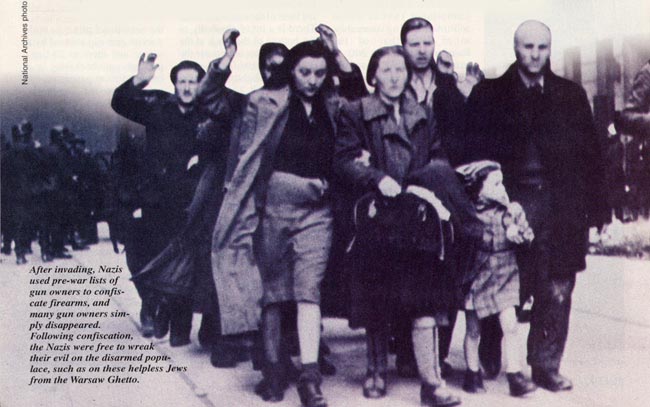
After invading, Nazis used pre-war lists of gun owners to confiscate firearms, and many gun owners simply disappeared. Following confiscation, the Nazis were free to wreak their evil on the disarmed populace, such as on these helpless Jews from the Warsaw Ghetto.
I

t would be instructive at this time to recall why the American citizenry and Congress have historically opposed the registration of firearms. The reason is plain. Registration makes it easy for a tyrannical government to confiscate firearms and to make prey of its subjects. Denying this historical fact is no more justified than denying that the Holocaust occurred or that the Nazis murdered millions of unarmed people.

I am writing a book on Nazi policies and practices which sought to repress civilian gun ownership and to eradicate gun owners in Germany and in occupied Europe. The following sampling of my findings should give pause to the suggestion that draconian punishment of citizens for keeping firearms necessarily is a social good.

The Night of the Broken Glass (Kristallnacht)--the infamous Nazi rampage against Germany's Jews--took place in November 1938. It was preceded by the confiscation of firearms from the Jewish victims. On Nov. 8, the New York Times reported from Berlin, "Berlin Police Head Announces 'Disarming' of Jews," explaining:

The Berlin Police President, Count Wolf Heinrich von Helldorf, announced that as a result of a police activity in the last few weeks the entire Jewish population of Berlin had been "disarmed" with the confiscation of 2,569 hand weapons, 1,702 firearms and 20,000 rounds of ammunition. Any Jews still found in possession of weapons without valid licenses are threatened with the severest punishment.1

On the evening of Nov. 9, Adolf Hitler, Propaganda Minister Joseph Goebbels, and other Nazi chiefs planned the attack. Orders went out to Nazi security forces: "All Jewish stores are to be destroyed immediately . . . . Jewish synagogues are to be set on fire . . . . The Führer wishes that the police does not intervene. . . . All Jews are to be disarmed. In the event of resistance they are to be shot immediately."2

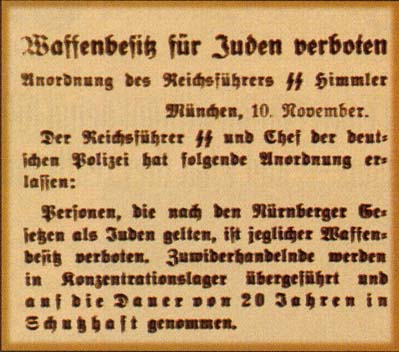
All hell broke loose on Nov. 10: "Nazis Smash, Loot and Burn Jewish Shops and Temples." "One of the first legal measures issued was an order by Heinrich Himmler, commander of all German police, forbidding Jews to possess any weapons whatever and imposing a penalty of twenty years confinement in a concentration camp upon every Jew found in possession of a weapon hereafter."3 Thousands of Jews were taken away.


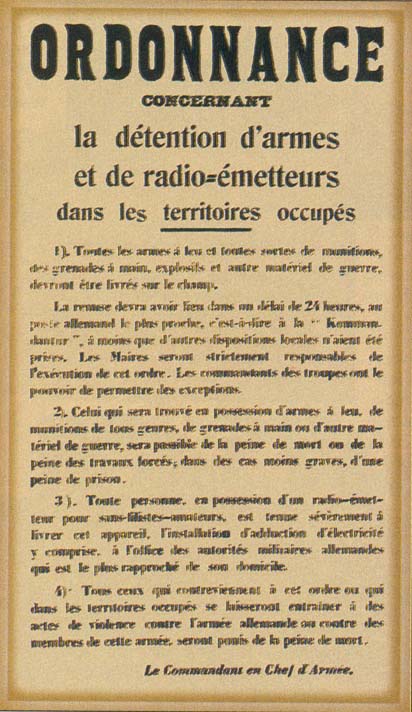
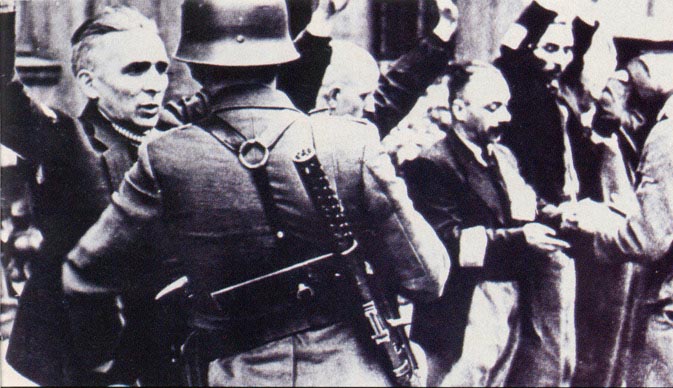
Invading Nazi troops in Holland in 1940 immediately nailed up posters announcing a ban on all firearms. From Die Deutsche Wochenshau, May 15, 1940.
Searches of Jewish homes were calculated to seize firearms and assets and to arrest adult males. The American Consulate in Stuttgart was flooded with Jews begging for visas: "Men in whose homes old, rusty revolvers had been found during the last few days cried aloud that they did not dare ever again return to their places of residence or business. In fact, it was a mass of seething, panic-stricken humanity."4

Himmler, head of the Nazi terror police, would become an architect of the Holocaust, which consumed six million Jews. It was self evident that the Jews must be disarmed before the extermination could begin.

Finding out which Jews had firearms was not too difficult. The liberal Weimar Republic passed a Firearm Law in 1928 requiring extensive police records on gun owners. Hitler signed a further gun control law in early 1938.

Other European countries also had laws requiring police records to be kept on persons who possessed firearms. When the Nazis took over Czechoslovakia and Poland in 1939, it was a simple matter to identify gun owners. Many of them disappeared in the middle of the night along with political opponents.

Imagine that you are sitting in a movie house in Germany in May 1940. The German Weekly Newsreel comes on to show you the attack on Holland, Belgium, and France.5 The minute Wehrmacht troops and tanks cross the Dutch border, the film shows German soldiers nailing up a poster about 2½ by 3 feet in size. It is entitled "Regulations on Arms Possession in the Occupied Zone" ("Verordnung über Waffenbesitz im besetzen Gebiet"). The camera scans the top of the double-columned poster, written in German on the left and Flemish on the right, with an eagle and swatiska in the middle. It commands that all firearms be surrendered to the German commander within 24 hours. The full text is not in view, but similar posters threatened the death penalty for violation.

The film shows artillery and infantry rolling through the streets as happy citizens wave. It then switches to scenes of onslaughts against Dutch and Belgian soldiers, and Hitler's message that this great war would instate the 1000-year Reich. A patriotic song mixed with the images and music of artillery barrages, Luftwaffe bombings, and tank assaults compose the grand finale.


German poster from occupied France imposing the death penalty for not turning in all firearms and radio transmitters within 24 hours (click for closeup). For translation, see below. From Musée de l'Ordre de la Libération, Paris.

Ordinance Concerning the Possession of Arms and Radio Transmitters in the Occupied Territories

1) All firearms and all sorts of munitions, hand grenades, explosives and other war materials must be surrendered immediately.
Delivery must take place within 24 hours to the closest "Kommandantur" [German commander's office] unless other arrangements have been made. Mayors will be held strictly responsible for the execution of this order. The [German] troop commanders may allow exceptions.

2) Anyone found in possession of firearms, munitions, hand grenades, or other war materials will be sentenced to death or forced labor or in lesser cases prison.

3) Anyone in possession of a radio or a radio transmitter must surrender it to the closest German military authority.

4) All those who would disobey this order or would commit any act of violence in the occupied lands against the German army or against any of its troops will be condemned to death.

The Commander in Chief
of the Army

France soon fell, and the same posters threatening the death penalty for possession of a firearm went up everywhere. You can see one today in Paris at the Museum of the Order of the Liberation (Musée de l'Ordre de la Libération). A photograph of the poster is reproduced here, including a translation in the sidebar.

There was a fallacy to the threat. No blank existed on the poster to write in the time and date of posting, so one would know when the 24-hour "waiting period" began or ended. Perhaps the Nazis would shoot someone who was an hour late. Indeed, gun owners even without guns were dangerous because they knew how to use guns and tend to be resourceful, independent-minded persons. A Swiss manual on armed resistance stated with such experiences in mind:

Should you be so trusting and turn over your weapons you will be put on a "black list" in spite of everything. The enemy will always need hostages or forced laborers later on (read: "work slaves") and will gladly make use of the "black lists." You see once again that you cannot escape his net and had better die fighting. After the deadline, raids coupled with house searches and street checks will be conducted.6

Commented the New York Times about the interrelated rights which the Nazis destroyed wherever they went:

Military orders now forbid the French to do things which the German people have not been allowed to do since Hitler came to power. To own radio senders or to listen to foreign broadcasts, to organize public meetings and distribute pamphlets, to disseminate anti-German news in any form, to retain possession of firearms--all these things are prohibited for the subjugated people of France . . . .7

While the Nazis made good on the threat to execute persons in possession of firearms, the gun control decree was not entirely successful. Partisans launched armed attacks. But resistance was hampered by the lack of civilian arms possession.

In 1941, U.S. Attorney General Robert Jackson called on Congress to enact national registration of all firearms.8 Given events in Europe, Congress recoiled, and legislation was introduced to protect the Second Amendment. Rep. Edwin Arthur Hall explained: "Before the advent of Hitler or Stalin, who took power from the German and Russian people, measures were thrust upon the free legislatures of those countries to deprive the people of the possession and use of firearms, so that they could not resist the encroachments of such diabolical and vitriolic state police organizations as the Gestapo, the Ogpu, and the Cheka."9

Rep. John W. Patman added: "The people have a right to keep arms; therefore, if we should have some Executive who attempted to set himself up as dictator or king, the people can organize themselves together and, with the arms and ammunition they have, they can properly protect themselves. . . ."10

Only two months before the Japanese sneak attack on Pearl Harbor, Congress enacted legislation to authorize the President to requisition broad categories of property with military uses from the private sector on payment of fair compensation, but also provided:

Nothing contained in this Act shall be construed--

(1) to authorize the requisitioning or require the registration of any firearms possessed by any individual for his personal protection or sport (and the possession of which is not prohibited or the registration of which is not required by existing law), [or]

(2) to impair or infringe in any manner the right of any individual to keep and bear arms . . . .11

Meanwhile Hilter unleashed killing squads called the Einsatzgruppen in Eastern Europe and Russia. As Raul Hilberg observes, "The killers were well armed . . . . The victims were unarmed."12 The Einsatzgruppen executed two million people between fall 1939 and summer 1942. Their tasks included arrest of the politically unreliable, confiscation of weapons, and extermination.13

Typical executions were that of a Jewish woman "for being found without a Jewish badge and for refusing to move into the ghetto" and another woman "for sniping." Persons found in possession of firearms were shot on the spot. Yet reports of sniping and partisan activity increased.14

Armed citizens were hurting the Nazis, who took the sternest measures. The Nazis imposed the death penalty on a Pole or Jew: "If he is in unlawful possession of firearms, . . . or if he has credible information that a Pole or a Jew is in unlawful possession of such objects, and fails to notify the authorities forthwith."15

Given the above facts, it is not difficult to understand why the National Rifle Association opposed gun registration at the time and still does. The American Riflemen for February 1942 reported:

From Berlin on January 6th the German official radio broadcast--"The German military commander for Belgium and Northern France announced yesterday that the population would be given a last opportunity to surrender firearms without penalty up to January 20th and after that date anyone found in possession of arms would be executed."

So the Nazi invaders set a deadline similar to that announced months ago in Czecho-Slovakia, in Poland, in Norway, in Romania, in Yugo-Slavia, in Greece.

How often have we read the familiar dispatches "Gestapo agents accompanied by Nazi troopers swooped down on shops and homes and confiscated all privately-owned firearms!"

What an aid and comfort to the invaders and to their Fifth Column cohorts have been the convenient registration lists of privately owned firearms--lists readily available for the copying or stealing at the Town Hall in most European cities.

What a constant worry and danger to the Hun and his Quislings have been the privately owned firearms in the homes of those few citizens who have "neglected" to register their guns!16

During the war years the Rifleman regularly included pleas for American sportsmen to "send a gun to defend a British home.17 British civilians, faced with the threat of invasion, desperately need arms for the defense of their homes." Indeed, the New York Times carried the same solicitations. After two decades of gun control, British citizens now desperately needed rifles and pistols in their homes, and they received the gifts with great appreciation. Organized into the Home Guard, armed citizens were now ready to resist the expected Nazi onslaught.

With so many men and guns sent abroad to fight the war, America still needed defending from expected invasions on the East and West coasts, domestic sabotage, and Fifth Column activity. Sportsmen and gun clubs responded by bringing their private arms and volunteering for the state protective forces.18

Switzerland was the only country in Europe, indeed in the world, where every man had a military rifle in his home. Nazi invasion plans acknowledged the dissuasive nature of this armed populace, as I have detailed in my book Target Switzerland: Swiss Armed Neutrality in World War II (Rockville Center, N.Y.: Sarpedon Publishers, 1998).


Resistance to Nazi oppression was hampered by the lack of civilian arms possession. One of the most notable exceptions was the Warsaw Ghetto Uprising in 1943, which began with a few incredibly brave Jews armed with handguns. They were able to temporarily stop deportations of Jews to Nazi extermination camps.
Out of all the acts of armed citizen resisters in the war, the Warsaw Ghetto Uprising of 1943 is difficult to surpass in its heroism. Beginning with just a few handguns, armed Jews put a temporary stop to the deportations to extermination camps, frightened the Nazis out of the ghetto, stood off assaults for days on end, and escaped to the forests to continue the struggle. What if there had been two, three, many Warsaw Ghetto Uprisings?

The NRA trained hundreds of thousands of Americans in rifle marksmanship during the war. President Harry Truman wrote that NRA's firearms training programs "materially aided our war effort" and that he hopped "the splendid program which the National Rifle Association has followed during the past three-quarters of a century will be continued."20 By helping defeat the Nazi and Fascist terror regimes, the NRA helped end the Holocaust, slave labor, and the severest oppression.

Those tiny pacifist organizations of the era which called for gun registration and confiscation contributed nothing to winning the war or to stopping the genocide. Their counterparts today have nothing to offer that would enable citizens to resist genocide.

Individual criminals wreak their carnage on individuals or small numbers of people. As this century has shown, terrorist governments have the capacity to commit genocide against millions of people, provided that the people are unarmed. Schemes to confiscate firearms kept by peaceable citizens have historically been associated with some of the world's most insidious tyrannies. Given this reality, it is not surprising that law-abiding gun owners oppose being objects of registration.


1. New York Times, Nov. 9, 1938, 24.

2. Gerald Schawb, The Day the Holocaust Began (New York: Praeger, 1990), 22.

3. New York Times, Nov. 11, 1938, 1, 4.

4. The Holocaust, Vol. 3, The Crystal Night Pogrom, John Mendelsohn, ed. (New York: Garland, 1982), 183-84.

5. Die Deutsche Wochenschau, No. 506, 15 May 1940, UfA, Ton-Woche.

6. Major H. von Dach, Total Resistance (Boulder: Paladin Press, 1965), 169. Earlier published as Dach, Der Totale Widerstand (Biel: SUOV, 2nd ed., 1958).

7. New York Times, July 2, 1940, 20.

8. New York Times, Jan. 4, 1941, 7.

9. 87 CONG.REC., 77th Cong., 1st Sess., 6778 (Aug. 5, 1941).

10. Id. at 7102 (Aug. 13, 1941).

11. Property Requisition Act, P.L. 274, 77th Cong., 1st Sess., Ch. 445, 55 Stat., pt. 1, 742 (Oct. 16, 1941). See. Halbrook, "Congress Interprets the Second Amendment," 62 Tennessee Law Review 597, 618-31 (Spring 1995).

12. Raul Hilberg, The Destruction of the European Jews (New York: Homes and Meir, 1985), 341, 318, 297.

13. Yitzhak Arad et al. eds., The Einsatzgruppen Reports (New York: Holocaust Library, 1989), ii.

14. Id. at 233, 306, 257-58, 352-53, 368.

15. Reichsgesetzblatt, I, 759 (4 Dec. 1941).

16. "The Nazi Deadline," American Rifleman, February 1942, at 7.

17. American Rifleman, Nov. 1940.

18. E.g., Report of the Adjutant General for 1945, at 23-24 (Richmond, Va., 1946); U.S. Home Defense Forces Study 58-59 (Office of Ass't Sec. of Defense 1981).

19. See Rotem (Kazik), Simha, Memoirs of a Warsaw Ghetto Fighter, (New Haven: Yale University Press, 1994), 118-19; David I. Caplan, "Weapons Control Laws: Gateways to Victim Oppression and Genocide," in To Be a Victim: Encounters with Crime and Injustice, eds. Diane Sank and David I. Caplan (New York: Plenum Press, 1991), 310.

20. Letter of Pres. Truman to C.B. Lister, NRA Sec.-Treas., Nov. 14, 1945.

************************************************************************************************

COLD STEEL VOYAGER KNIFE - RECOMMENDED

Cold Steel large Voyager Series clip point

FROM BOSTON - MUST READ

http://www.boston.com/news/local/massachusetts/articles/2008/02/09/police_set_to_search_for_guns_at_homes/

************************************************************************************************

FOR COMPLETE MAKAROV ARTICLE GO TO
http://actionsbyt.typepad.com/actionsbyt/2008/02/makarov-article.html

********************************************
NEW GUNSMITH FORUM
http://thegunsmiths.com/phpBB2/

********************************************

www.actionsbyt.com

www.actionsbyt.blogspot.com

www.tacticalknives.blogspot.com

www.actionsbyt.typepad.com

www.actionsbyt.wordpress.com

www.truthaboutparts.blogspot.com

www.commentsbyt.blogspot.com

www.tjofsugarland.blogspot.com

www.handgunpartsforsale.blogspot.com

www.hipowersandhandguns.com

www.mouseguns.com

www.trippresearch.com

www.wowtexas.com

http://www.spw-duf.info/links.html#guns

***********************************************************
DO NOT DISTURB - THIS ISLAMIC TERRORIST IS NOW IN PARADISE WITH HIS 72 VIRGINS. HE WAS RUN OVER BY A BRADLEY.

****************************************************************************************