DEC. 21, 2012 Friday - 5773
My Email has been hacked and I am not in the Philippines, Its a scam. Please ignore and I am truly sorry if they have bothered you. Teddy Jacobson. Texas

Mouseguns/Pocketguns for Self-Defense - Selection and Tactics
Disclaimer: I am not
a lawyer. I am not handing out legal advice. I make no claim to be an
expert on the use of firearms. The following are just my personal
opinions and observations. If you carry a concealed weapon, you and you
alone are responsible for your own actions. Also, I am writing this
article from the standpoint of a "civilian," not a law enforcement
officer (LEO). Different rules and tactics apply for LEOS.
Choosing a Mousegun/Pocketgun
I define a "mousegun" as a handgun that weighs less than 16
ounces empty, and/or will fit easily in a front pants pocket. This is
my own personal definition, so take it or leave it. If you want to
define a mousegun some other way, that's fine with me. A pocketgun is
obviously one that you carry in your pocket.
There are many choices in the mousegun world. There are
derringers, semi-auto pistols, and revolvers. There are all kinds of
calibers available, from .22 long rifle on up to shotgun shells. With
single or double shot derringers in particular, you can get any caliber
you like, and still stay under 16 ounces, and have a pocketable firearm.
On the other hand, one or two shots isn't much. What if you have two
assailants? How will you defend yourself? A few extra rounds would
come in handy!
My personal recommendation for a mousegun/pocketgun is some sort
of semi-auto pistol in either 9mm or .380acp. Why choose a small .32acp
pistol, when you can shoot a more powerful .380acp pistol that is about
the same size and weight? And if you can pocket a 9mm pistol, why
settle for the smaller .380acp? Of course, price and availability come
into the equation, as well as "shootability." The 9mm round in a very
small pistol may be too much for some people to handle well and
comfortably. And a $1000 9mm Rohrbaugh pistol may be an ideal choice
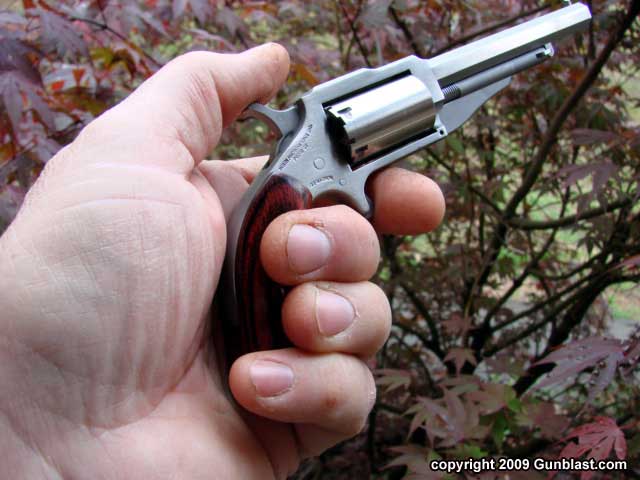
for you, but beyond your budget. The small .22 revolvers by North
American Arms are too small in my opinion. And they are single-action
only, which means they are difficult to shoot quickly or accurately in
stressful situations. The grip is very small, and they are hard to
hold. It is also my personal opinion (with which many will disagree)
that the small j-frame S&W pistols are still a bit too large for
comfortable pocket carry. You may feel differently, and if the j-frame
works for you, that's great!
Here are some photos of some well-known pocket guns...

Kel-Tec P3AT (.380 ACP)
|

S & W 342PD
|

Kahr PM9 (9mm)
|
Choosing a pistol is also a very personal decision. You need a
pistol that you like. It doesn't matter what anyone else says about it.
If you don't like it, then it's not for you. It also needs to be
reliable, and you can't take anyone's word about which pistols are
reliable. Get yourself a pistol you like, and work with it. Shoot it
enough so that you are confident that it will go bang if you have to
pull the trigger in a time of great need. Carry it it your pocket long
enough that you are confident in your ability to conceal your firearm,
and carry it all day long without feeling burdened by it. I love the
GLOCK 27 pistol for front pocket carry in my khaki pants. But because
it is a bit larger and heavier than most pocket pistols, I had to work
up to it. My first pocketgun was a Kel-Tec p3at. Then I found the
Kel-Tec PF9, which would fit well in my pocket. Finally I found a
holster that really worked well with the GLOCK 27. So, the GLOCK 27 is
NOW my personal choice, but it may not work for you, for a pocket gun.
My choice for a pocketgun is really two choices, one for weekdays
and one for Sunday. I go to church every Sunday, and I wear a suit.
On week days I wear khaki slacks. On weekdays I find that I can
comfortably conceal my GLOCK 27 in my khaki pants front pocket. But I
can't do it in my thinner suit pants on Sunday. The material is too
thin, and the pants are a little tighter, and the GLOCK just won't
conceal well and feel comfortable. So when I wear a suit, I carry a
Kel-Tec P3AT in my front pocket, and that works very well. The Kahr PM9
and the Ruger LCP (.380acp), or a Seecamp .380 also seem to me to be
fine pocketable mouseguns. Some people like the .380 pistols from North
American Arms, which are small, but they are a bit heavier. The brand
doesn't matter. Find one that conceals easily, is comfortable to carry
all day long, and is reliable in your personal experience.
Someone is probably objecting: if you are wearing a sport coat,
or a suit coat, then you don't need to carry a mousegun at all! Just
carry a larger gun with an IWB (in the waist band) holster, and your
coat will conceal it. That's true. However, I find that I am often
removing my coat for one reason or another, and the larger guns won't
work for me, for absolute concealment. I like a pocketgun, in my front
pants pocket. That's what works for me. If you want to carry a larger
gun some other way, and if that works with your lifestyle, then go for
it! I would if I could, but I can't. If you wear bluejeans every day,
with an oversized untucked shirt, well don't worry about a mousegun! I
think if that was my daily dress I would carry a GLOCK 22 or a 1911
style .45 all the time. Don't worry too much about caliber. Any
caliber will do, if the bullets are placed in vital zones.
For more suggestions about choosing a mousegun,
click here for my web page about "Defining a True Pocket Pistol."
Avoid Bullets That Over-Penetrate
One of Jeff Cooper's Four Laws for Firearms is: "Be aware of
what is beside or behind your target." We should all have memorized the
four laws a long time ago. Here they are for a refresher...
- 1. All guns are always loaded.
- 2. Never, ever point a gun at anything you don't want to destroy.
- 3. Never, ever touch the trigger with your finger until you are ready to shoot.
- 4. Always be aware of what is beside or behind your target.
Cooper's Fourth Law makes us think twice about our ammunition.
Full-metal-jacket bullets can easily pass all the way through a "Bad
Guy," and hit another person standing behind the BG. This is
"over-penetration." Too much penetration is a bad thing, and may lead
to injuring innocent bystanders. You don't want to end up shooting a
good person, and bringing about the very grief you are trying to
prevent! For .380 pistols, FMJ bullets are probably OK. They will
probably not go all the way through the body of a BG. If your pistol
shoots .22 bullets, then use hollow points. The smallness of the .22
bullet makes it a slick penetrator. For 9mm, .40S&W or .45acp,
hollow points are preferable, as they will expand inside the BG, and
won't over-penetrate.
Here is a photograph illustrating full-metal-jacket versus hollow-point bullets...
 Mousegun/Pocketgun Tactics
The most important factor with regard to tactics is a realitic admission of the limitations of a mousegun.
Mousegun/Pocketgun Tactics
The most important factor with regard to tactics is a realitic admission of the limitations of a mousegun.
A mousegun is not suitable for engaging bad guys at long distance.
Mouseguns are weapons of last resort, meant to be used really close up
and personal. The purpose of a mousegun is simply to give you an edge -
a chance to get out with your life. Sights are rudimentary, and
mouseguns are not tack drivers. They are not range guns. They are not
rifles. Most mouseguns are designed to be "shot little and carried
often," not the other way around. If you are under pressure, and are
armed with a mousegun, you will do amazingly well to hit a man-sized
target at three yards. Fast, excited shooting at over three yards is
very iffy.
One reason I am delighted that I have found a way to carry my
GLOCK 27 in my pocket is that it is not exactly a mousegun. It shoots
40S&W rounds, compared to the less powerful .380 in my Kel-Tec P3AT.
It is 100% reliable, and I find that it is quite accurate at 20 yards.
If you can get comfortable with a pocketgun that is really more than a
mousegun, that's the way to go.
Whatever pistol you carry, be aware that if you shoot at a bad
guy who is more than just a few yards away, you are opening yourself up
for a homicide charge. You may ONLY use your firearm if you are truly
in life-threatening danger. If the bad guy is more than seven yards
away, your life is probably not at risk, and legally (maybe not morally)
it is your duty to run, not to fire your weapon, UNLESS YOU ARE A
POLICEMAN. Then different rules apply.
Mouseguns are not suitable for firefights. If you are armed with
only a mousegun, you do NOT run towards the gunfire. Mouseguns are
strictly for personal defense. For example, if you happen to be in a
shopping mall, and you hear and see a BG (bad guy) 40 yards down the
hallway with an AK47, you had better realize right away that you are
simply not equipped to go into battle.
Grab your loved ones if they are near, and turn and run away as fast as you can. Discretion is the better part of valor.
On the other hand, if you are near the BG when he pulls his AK47 out
from under his coat, by all means do your best to draw and take him out.
You are too close to run away, and close enough to hit your target.
If you are in an armed robbery situation in a restaurant, and the
robbery is going on a room's length away, and you are not personally
threatened, then keep your seat, and do no more than get ready.
If
you can see your way to a rear exit, and think you can get out before
the BG notices and shoots at you, then get up and leave. Get
your mousegun ready for use, draw it invisibly (under the table would be
good), but don't use it unless you must. Maybe the BG won't come to
your area of the restaurant. You are not there to be a hero. Your
mousegun doesn't give you enough firepower to enable you to be a hero.
You are not a policeman, either, so don't try to act like one.
Remember
this: THE BEST USE OF A MOUSEGUN IS NOT TO HAVE TO USE IT AT ALL.
When I say to use it only as a last resort, I mean it! Use it ONLY when
you have NO OTHER OPTION AT ALL.
If you are eating in a restaurant, and an armed BG comes in, and
starts lining up the patrons, or herding them to a back room, and you
have no escape route, you need to be ready for a more aggressive
approach. If the BG is a room's length away from you, your mousegun may
not be accurate enough to hit the BG, and if you try you may hit
innocent patrons. But a deeply concealed mousegun may give you the edge
you need to survive and even rescue others. How to use your mousegun
in such a situation: 1) If possible, put your hand on your gun and get
a good grip; 2) Wait for the BG to get within three yards of you - two
is better than three; 3) Stand or sit with your "weak side" towards the
BG, and draw your mousegun in such a way that the BG can't see what you
are doing; 4) When the BG is not looking directly at you, and his
firearm is not pointed at you in particular, immediately turn and
immediately fire at the BG.
As Tuco said in the film
The Good, the Bad and the Ugly,
"When you have to shoot, shoot, don't talk." DON'T TALK TO THE BG.
Don't say "stop or I'll shoot." Don't say, "Freeze." Don't say "Drop
your weapon." Don't say anything at all, just shoot immediately and
without any warning.
Shot placement is more important than bullet
caliber, so shoot into the center of mass, into the neck, or the head
of the BG. If you are really up close (within three feet), go for the
head shot first. Don't stop shooting until the BG is
"stopped." "Stopped" means that he is no longer a threat. Perhaps he
has dropped his weapon. Perhaps he is unconcious. You will have to
judge the situation, but be certain he has been STOPPED. If he is still
moving and still firmly gripping his weapon, he has not yet been
stopped. He should be considered dangerous and a threat to your life
and the lives of those around you as long as his weapon is in his hand.
Another thought (suggested by a reader at the USRange):
"Consider taking one step to either side to provide a 'clearer'
background (taking innocent bystanders out of the picture - either
behind your intended target or behind you, in the event he returns
fire)." This is in line with Cooper's Fourth Rule for safe gun
handling. "Always be sure of what is behind or beside your target."
If there is more than one BG, and you have no clear exit, you
should use your mousegun to take out the one nearest you. If you are
successful, the second BG may flee, or he may shoot YOU. If he is not
close to you, it will be difficult for you to engage him with a
mousegun. If stopping the BG near you gives you an opportunity to flee
out the door, do so. You are not a policeman. You probably can't do a
one-man rescue of everyone there. If you can flee, then flee. On the
other hand, if the first BG has a rifle, or a larger handgun, you may be
able to take it, and use it against a second BG. If there are more
than two Bad Guys doing the crime, your goose is probably cooked. It's
an uncertain situation, and as always, you are in God's hands. We may
be brave and clever, or we may be stupid, but it is certainly God who
decides the ultimate outcome. Silent prayer is not a bad idea, but
don't close your eyes!
Summarizing Mousegun Tactics
- 1 Keep your firearm concealed as long as you can, until you are within three yards of the BG.
- 2 Try to get a grip on your mousegun while it is still concealed in your pocket. This will give you a faster draw.
- 3 Don't forget that you only have a mousegun. It is not a
"go to battle" weapon. It is an "escape" weapon - a weapon of last
resort. Your objective is not to defeat the Bad Guys. Your objective
is to save your own life. If you can exit the scene before drawing your
firearm, then EXIT.
- 4 Draw from your invisible side, when the BG is not looking directly at you.
- 5 If it is time to shoot, then shoot. Don't talk, shoot.
- 6 Place your shots in vital areas, and shoot until the BG is stopped.
- 7 Pray silently for God to guide and bless - I'm not kidding.
Finally, when the shooting is over, and the BG is not a threat any
longer, put your gun back in your pocket or holster, and call 911, and
inform the person on the line that "there was a self-defense shooting
at" your location. Don't say that you are the shooter. Don't say
anything else. Don't tell anyone where your mousegun is. Just put your
mousegun in your pocket, and join the rest of the crowd, and wait for
the police. Don't leave the scene. Don't talk to the other people
about the shooting. Keep cool and keep quiet. Keep your mousegun in
your pocket. "Out of sight is out of mind."
Half of the people there won't remember exactly what you did or
did not do. They will not remember accurately what you said. It's
better to keep quiet. They will all be witnesses at your trial, if
there is one, and you may very well be arrested and charged with a
homicide. You may also be sued by the BG for a million dollars, if he
survives. So keep your mouth shut. WHATEVER you say may be used
against you in court.
(A friendly and wise reader sent me the following email
about the above paragraph, and I insert it here, because I agree with
him about supporting the NRA-ILA. The NRA is a great help to gun
owners.)
"This is a REAL and serious threat to law-abiding CCWers even in
"good shoots." Fortunately, the NRA-ILA is well aware of it and has been
fighting to pass their model Castle Doctrine law in states throughout
the nation. Half of the states have passed it so far.
"For info on their model law, see:
http://www.nraila.org/Issues/FactSheets/Read.aspx?id=188
"For their successes in passing their model law, see:
http://www.nraila.org/maps/cd.jpg
"I encourage you to encourage your readers to join the NRA and
help pass this law in more states. If nothing else, please encourage
your readers to sign up for the NRA-ILA's free email alerts so they know
when to help the NRA pass this, and other pro-RKBA laws, when the time
is right. See:
https://secure.nraila.org/EmailSignup.aspx"
When the police show up, just obey orders like everyone else. When
they ask "Who shot the BG," raise your hand slowly and say "I was afraid
for my life." Don't pull your mousegun out of your pocket until they
order you to do so. Do exactly what they tell you to do, right away.
Don't argue. Don't say anything except, "I was afraid for my life.
That's all I can think about right now." Don't boast about what you
did. If you are taken into custody, don't talk with the police about
the shooting. Just say, "I was afraid for my life."
You should
have already called your lawyer, right after the 911 call. If you have a
permit to carry a concealed gun, you should also have already found a
lawyer who handles firearm self-defense cases; and his card should be in
your wallet right now. Don't talk with anyone else about what happened.
Some lawyers advise you to NEVER talk with the police. Not just
in the few minutes after an incident but NEVER. An innocent person
(YOU) can be hung by his/her own seemingly innocent words. For example,
suppose a murder happens and you tell the police truthfully that you
were 20 miles away, but there is no EVIDENCE of that. Then suppose a
witness makes an honest mistake and genuinely but incorrectly says he
saw you two blocks from the murder. Your talking (and telling the
truth) has you caught in a perceived "lie" that will look bad and help
convict you. If you had not talked there would only be a witness putting
you in the area. There are many other risks that talking opens up.
For example, the police may make a genuine mistake and misquote what you
said. A policeman once commented: "Going into a interview with an
experienced LEO thinking you can win is like going up against a pro
boxer and expecting to win. It is naive pride."
Xavier's Five Rules for Concealed Carry (From his Blog: Nurse with a Gun)
We all should know the Four Rules of Firearms Safety. They should
be ingrained in our bones. Recently I read of the Five Rules of
Concealed Carry. It was a good start, but did not quite make the grade. I
have borrowed heavily from them though, and present my own Rules of
Concealed Carry here.
1. Your concealed handgun is for protection of life only.
Draw your concealed firearm solely in preparation to protect yourself or
an innocent third party from the wrongful and life threatening criminal
actions of another. A CCW license does not give you any greater rights
or responsibilities than any other citizen. It merely provides you with
the means of legally carrying a firearm to protect your own life or the
lives of others.
2. Know exactly when you can use your gun.
A criminal adversary must have, or reasonably appear to have:
a. the ability to inflict serious bodily injury (he is armed, reasonably
appears to be armed with a deadly weapon, or a considerable disparity
of force exists),
b. the opportunity to inflict serious bodily harm (he is physically positioned to harm you), and
c. his intent (hostile actions or words) indicates that he means to
place you in jeopardy -- to do you serious or fatal physical harm.
When all three of these "attack potential" elements are in place
simultaneously, then you are facing a reasonably perceived deadly threat
that can justify an emergency deadly force response.
3. If you can run away -- RUN!
Just because you are armed does not necessarily mean you must confront a
bad guy at gunpoint. Develop your "situation awareness" skills so you
can be alert to detect and avoid trouble altogether. Keep in mind that
if you successfully evade a potential confrontation, the single negative
consequence involved might be your bruised ego, which should heal with
mature rationalization. By contrast, if you force a confrontation you
risk the possibility of you or a family member being killed or suffering
lifelong crippling/disfiguring physical injury, criminal liability
and/or financial ruin from a civil lawsuit. Flee if you can, fight only
as a last resort.
4. Display your CCW, be prepared to go to jail.
You should expect to be arrested by police at gunpoint, and be charged
with a crime anytime your concealed handgun is seen by another citizen
in public, regardless of how unintentional, innocent or justified the
situation might seem. Choose a method of carry that keeps your gun
reliably hidden from public view at all times.
You have no control over how a stranger will react to seeing (or
learning about) your concealed handgun. He or she might become alarmed
and report you to police as a "man or woman with a gun." Depending on
his or her feelings about firearms, this person might be willing to
maliciously embellish his or her story in an attempt to have your gun
seized by police or to get you arrested. An alarmed citizen who reports a
"man with a gun" is going to be more credible to police than you when
you are stopped because you match the suspect's description, and you are
found to have a concealed handgun in your possession. Under these
circumstances, you have been accused, apprehended, and are in a
defensive position. If you must draw your gun, make certain you are the
first to notify police.
Before you deliberately expose your gun in public, ask yourself: "Is
this worth going to jail for?" The only time this question should
warrant a "yes" response is when an adversary has at least, both ability
and intent, and is actively seeking the opportunity to do you great
harm.
5. Don't let your emotions get the best of you.
Develop and practice self control. If, despite your best efforts to the
contrary, you do get into some kind of heated dispute with another
person while you are armed, never mention, imply or exhibit your gun for
the purpose of intimidation or one-upmanship. You will simply make a
bad situation worse -- for yourself. You can carry a gun, or you can
have a temper. You may even do both for a while, but it will not last
very long.
With the growing population of gun toters, it is imperative that
we establish a few simple guidelines to help introduce others into the
world of concealed carry. These five are the best I've found.
Xavier has also written "The Concealed Carry Creed," which is worth reading and reciting from time to time:
- My weapon is for the protection of my life and the lives of others.
That is its sole purpose. It does not confer rights, responsibilities
or authority greater than that of other citizens. It merely allows me to
protect life.
- I will seek never to have to use my weapon. If I can avoid
conflict, I will. If I can resolve conflict, I will. If I can escape
danger, I will. If I am forced to bring my weapon to bear and use it, I
will.
- I will acquire superior training with my weapon. It is not
the weapon that saves lives, but my effective use of the weapon. I will
ensure my training is sound, my knowledge is current, and my mind is
prepared.
- I will know, understand, and obey all laws and ordinances
concerning my weapon no matter where I happen to be. Failure to do so
harms all who seek to legally carry an effective means of self
protection.
- I will know and follow the Four Rules of safe gun
handling. I am a member of a growing community that must foster and
teach safe and responsible gun handling if the community is to survive.
Finally, read "The Mouse That Roared," (Ken Giorno)


 A Comment from JC..."A
great memorial to Dr. St. John. I am so happy to see this site back up
on its original domain. About 9 months ago, when I saw a Jimenez JA-22
in a local gun store at a really good price, I decided to do a little
research online before buying. Well, that research led me to
Mouseguns.com and I discovered a whole new world of small pistols, and I
had to learn more. I have now become an avid collector of mouse guns
all because of the wonderful reviews and information assembled on the
site by Dr. St. John. Thank you for continuing his work and keeping his
memory alive. I wish I had known him personally, but I almost feel like I
did because of the Mouseguns.com website.
"
A Comment from JC..."A
great memorial to Dr. St. John. I am so happy to see this site back up
on its original domain. About 9 months ago, when I saw a Jimenez JA-22
in a local gun store at a really good price, I decided to do a little
research online before buying. Well, that research led me to
Mouseguns.com and I discovered a whole new world of small pistols, and I
had to learn more. I have now become an avid collector of mouse guns
all because of the wonderful reviews and information assembled on the
site by Dr. St. John. Thank you for continuing his work and keeping his
memory alive. I wish I had known him personally, but I almost feel like I
did because of the Mouseguns.com website.
"


 June 7-11, 2011 -- Going gunless in Virginia...This
morning I will board a US Airways flight for Virginia Beach (Norfolk
International) via Charlotte, NC, and will be in Virginia Beach (at the
Convention Center) this afternoon, home of the giant bronze Neptune
statue. I suppose I could take a gun with me in my luggage, but from
what I read about it, it is just too much of a hassle. So I will be
unarmed except for my trusty ballpoint pen, and whatever is at hand. If
my flight is boarded by Zombies, I will roll up my in-flight US Airways
magazine, and smite them with it. My denomination, the Presbyterian
Church in America holds an annual "General Assembly." We move around
every year, and have met in Dallas, Charlotte, Chattanooga, Atlanta,
Orlando, Los Angeles, Louisville, Memphis, Nashville, and many other
places. I've only missed one meeting in the past 22 years. We are
strongest in the Southeastern USA, so we orbit around the South,
generally. There will be about 1200 pastors in Virginia Beach. How
would you like to spend four days with 1200 pastors? I will enjoy
myself, though I'm sure it is an acquired taste! I will not be home and
able to "blog" anymore until Saturday morning, so this will be my last
post until then.
June 7-11, 2011 -- Going gunless in Virginia...This
morning I will board a US Airways flight for Virginia Beach (Norfolk
International) via Charlotte, NC, and will be in Virginia Beach (at the
Convention Center) this afternoon, home of the giant bronze Neptune
statue. I suppose I could take a gun with me in my luggage, but from
what I read about it, it is just too much of a hassle. So I will be
unarmed except for my trusty ballpoint pen, and whatever is at hand. If
my flight is boarded by Zombies, I will roll up my in-flight US Airways
magazine, and smite them with it. My denomination, the Presbyterian
Church in America holds an annual "General Assembly." We move around
every year, and have met in Dallas, Charlotte, Chattanooga, Atlanta,
Orlando, Los Angeles, Louisville, Memphis, Nashville, and many other
places. I've only missed one meeting in the past 22 years. We are
strongest in the Southeastern USA, so we orbit around the South,
generally. There will be about 1200 pastors in Virginia Beach. How
would you like to spend four days with 1200 pastors? I will enjoy
myself, though I'm sure it is an acquired taste! I will not be home and
able to "blog" anymore until Saturday morning, so this will be my last
post until then.